What Is a HEPA Air Purifier?
Wondering how to improve the air quality in your home or car? A HEPA air purifier can help by capturing tiny airborne particles, making your space safer and more comfortable.
These devices use a specialized filter to trap at least 99.97% of particles as small as 0.3 microns, including dust, pollen, and pet dander.
Keep reading to find out how to choose the right one for you.
What Exactly Is a HEPA Air Purifier?
A HEPA air purifier uses a specialized filter known as a HEPA filter as its primary mechanical means of removing airborne particles. “HEPA” stands for High Efficiency Particulate Air. This type of filter is made of a dense, randomly arranged mesh of very fine fibers, usually fiberglass, designed to trap microscopic contaminants. The filter’s structure is typically pleated to maximize surface area, increasing its ability to capture particles without significantly restricting airflow. For those seeking a complete cooling solution, best window air conditioners often integrate similar filtration technology for improved indoor air quality. When comparing cooling options, portable vs window units can differ significantly in their airflow and filtration efficiency. Notably, this technology relies on capillary action to distribute the scent evenly, a principle also observed in diffusion processes.
The filtration process begins with a prefilter that catches larger debris such as dust and hair. The air then passes through the HEPA filter, which effectively traps smaller particles like pollen, pet dander, mold spores, and fine dust. Because of its dense fiber arrangement, a HEPA filter can remove at least 99.97% of particles as small as 0.3 microns in size.
It’s important to note that HEPA filters do not handle gases, odors, or chemicals. For those, an activated carbon filter is often integrated into the purifier to adsorb airborne gases and unpleasant smells. Overall, the combination of a prefilter, HEPA filter, and sometimes an activated carbon layer makes these purifiers highly effective at improving indoor air quality for people with allergies or sensitivities.
How HEPA Filters Capture 99.97% of Airborne Particles
HEPA filters capture at least 99.97% of airborne particles at 0.3 microns. This size, known as the Most Penetrating Particle Size, is the hardest to trap. The dense fiber matrix of a HEPA filter doesn’t rely on a simple screen. Instead, it forms a maze of ultra-fine, randomly arranged fibers. This structure makes air twist and turn, increasing the chances that particles will contact a fiber. Larger particles are pulled into fibers due to their inertia, while smaller ones are caught through random motion. Because 0.3 microns represent a challenging size for filtration, certification tests use this benchmark to verify efficiency. The actual filter performance improves for particles both smaller and larger than this size. Therefore, 99.97% efficiency at 0.3 microns indicates the filter’s worst-case performance, meaning only 0.03% of particles slip through. Understanding the science behind how humidifiers add moisture helps explain why they complement, rather than replace, mechanical filtration. Cool mist humidifiers can complement this filtration by adding moisture, but they do not replace the mechanical capture provided by a HEPA filter’s fiber maze. The filter’s fiber maze relies on three primary mechanisms—interception, impaction, and diffusion—to trap particles of varying sizes.
Impaction, Interception, and Diffusion: The Three HEPA Mechanisms
The three HEPA mechanisms that capture particles are impaction, interception, and diffusion. Each operates differently based on particle size and airflow behavior. Impaction targets larger, heavier particles by using their inertia: as airflow bends around fibers, these particles unable to follow the curved path collide directly with a fiber. Interception captures mid-sized particles when they come within one particle radius of a fiber while following the airflow, enabling their removal without significant deviation. Diffusion primarily traps the smallest particles by employing Brownian motion; random molecular collisions cause these particles to zigzag and bump into fibers. All three mechanisms work together to provide high filtration efficiency across the full spectrum of particle sizes, demonstrating that HEPA filters rely on complex physical interactions rather than simple sieving. For instance, straining physically blocks particles larger than the gaps between fibers. While these mechanical processes are highly effective for airborne pollutants, they do not address the underlying moisture issues that can promote biological growth. In such cases, a dehumidifier can help by reducing humidity levels to complement the filter’s particle removal, improving overall indoor air quality. Additionally, using a humidifier for cough relief can soothe irritated airways by adding moisture to dry air, which is a separate benefit from particle filtration. Regular cleaning of the fan blades and housing with a soft brush or vacuum attachment is key to preventing mold and buildup that can compromise airflow and air quality.
What Particles Can a HEPA Filter Actually Remove?
HEPA filters can remove particles as small as 0.01 microns. They are highly effective at trapping a wide range of airborne contaminants, far beyond the standard 0.3-micron benchmark. This includes pollen, dust, pet dander, mold spores, bacteria, and some viruses. Additionally, they trap smoke, soot, aerosols, fine combustion particles, and microscopic metal debris. While their efficiency varies between 99.95% and 99.97% for particles of 0.3 microns, they perform well across a broader size spectrum. For proper operation, correct placement is just as critical as the filter itself for maximizing performance. HEPA filters do not eliminate volatile organic compounds or gases, as those are not solid particles. When you choose a HEPA-certified purifier, you are selecting a tool capable of capturing many physical, biological, and combustion-related airborne threats. Similar to how a smart thermostat optimizes energy use through precise sensing, a HEPA purifier relies on consistent airflow management to maintain its high capture rates. As with space heaters, proper placement and airflow are essential to prevent overheating and ensure safe, efficient operation.
Where You’ll Find HEPA Filters in Daily Life
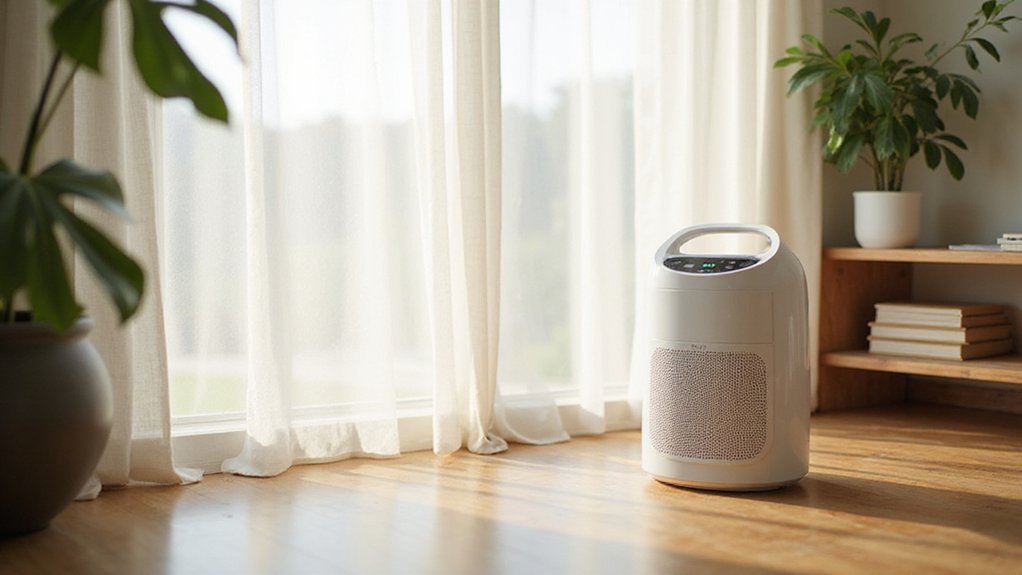
HEPA filters are found in many everyday devices that help keep your indoor air clean. Portable air purifiers commonly use HEPA filters to trap airborne allergens, dust, and pet dander, making the air healthier to breathe. Vacuum cleaners also incorporate HEPA filters at their core, capturing fine dust and allergens that might otherwise recirculate into the room. Your home’s HVAC system might feature a whole-house HEPA unit designed to filter pollen, smoke particles, and other airborne pollutants from the supply air. Additionally, cars and airplane cabins rely on HEPA filtration to reduce airborne pathogens and improve air quality for passengers. For optimal performance, selecting a portable air conditioner with an appropriate BTU rating ensures efficient cooling alongside any integrated HEPA filtration. To ensure these filters perform optimally, check them every three to six months. When a filter appears clogged or dirty, replace it promptly. This simple maintenance step keeps your HEPA filters working effectively, whether in portable purifiers, vacuum cleaners, or vehicle systems. For those managing respiratory conditions like bronchitis, choosing a top humidifier with HEPA filtration can further enhance indoor air quality by adding moisture while capturing irritants. Understanding how the technology works helps you appreciate why HEPA filters are so effective at capturing microscopic particles.
How HEPA Air Purifiers Improve Indoor Air Quality (and Help Allergies)
Keeping your HEPA filters clean is important, but understanding what they do for your air is even more crucial. HEPA filters trap 99.97% of particles at 0.3 microns—tiny particles that can penetrate deep into your lungs. They are particularly effective against small allergens like pollen, dust, and pet dander, significantly reducing indoor allergen levels. In real-world studies, HEPA purifiers have been shown to cut PM2.5 levels—particles smaller than 2.5 microns—by up to 56%. This decrease can lead to fewer allergy symptoms and less respiratory irritation. Unlike portable air conditioners that recirculate air without trapping these fine particles, HEPA filters actively remove allergens from the airflow. To maximize their effectiveness, ensure proper airflow and correct room placement of your purifier. For best results, choose a purifier with a clean air delivery rate matched to your room size. Regular maintenance is key; replacing your HEPA filter on schedule keeps it functioning at peak capacity. Neglecting maintenance can shorten filter lifespan and decrease its ability to trap tiny irritants. When your HEPA filter is kept clean and replaced regularly, you’ll breathe easier, with fewer sneezes and less overall respiratory discomfort. Many top-rated models for quality and performance undergo rigorous testing to ensure they meet these strict standards.
What HEPA Filters Can’t Remove: Odors, Gases, and Chemicals
HEPA filters can’t remove odors, gases, or chemicals because these molecules are too small for their dense fibrous mesh to catch. You’ll find that cooking smells, pet odors, or smoke vapors pass right through, leaving you disappointed. This is because HEPA filters are designed specifically to capture solid particles, not gaseous pollutants. To effectively control odors, you need a separate mechanism such as activated carbon or other sorbent media that adsorbs these substances. For example, just as a ceiling fan with LED light prioritizes lighting and airflow over particle filtration, a HEPA filter alone cannot address gaseous pollutants.
Gases like volatile organic compounds (VOCs) including formaldehyde, benzene, or ammonia also slip through HEPA filters. Fumes from cleaning products, building materials, or air fresheners are similarly too small for the filter to trap. Their fibrous structure targets only solid particles, not gaseous pollutants. To remove these gases from your air, you require specialized filters that contain activated carbon or similar materials capable of adsorbing chemical fumes. Without these, your purifier with only a HEPA filter will leave invisible gases circulating freely in your space. For comparison, some cooling devices like a portable air conditioner also rely on separate filter types to manage air quality, though they are not primarily designed for gas or odor removal.
CADR, ACH, and True HEPA: What to Check Before Buying
To ensure your air purifier actually cleans the air effectively, you need to check its Clean Air Delivery Rate (CADR). CADR measures how many cubic feet of filtered air the device delivers per minute for smoke, dust, and pollen. A higher CADR indicates faster removal of airborne particles. Match the CADR to your room size using the two-thirds rule: your purifier’s CADR should be at least two-thirds of your room’s square footage to be effective.
Next, calculate the air changes per hour (ACH) by dividing the CADR by the room volume and multiplying by 60. A higher ACH means the air in your space gets refreshed more often, ensuring better air quality. Beyond the numbers, verify that the purifier has True HEPA certification instead of just “HEPA-type” claims, since only True HEPA filters reliably capture at least 99.97% of particles. Combining a high CADR with a True HEPA filter and a design that promotes strong airflow will give you the most effective air cleaning. Also, consider how long the HEPA filter lasts; longer-lasting filters reduce ongoing replacement costs. Always compare independently certified CADR values before making your purchase.
How to Get the Most Out of Your HEPA Purifier at Home
To maximize your HEPA purifier’s effectiveness, run it continuously rather than in short bursts. Steady operation helps keep particle levels consistently low, especially during sleep hours in bedrooms. Position the unit at least 12 inches away from walls and furniture to promote optimal airflow. A central, open location works better than a corner spot because it allows the purifier to circulate air more evenly throughout the room.
Keep room windows and doors closed when the purifier is running. This prevents clean air from escaping outdoors and ensures the device recirculates the same air repeatedly. Regular filter maintenance is crucial: check pre-filters every two weeks for dust buildup and wash them monthly to prolong HEPA filter life. Replace carbon filters every three months and HEPA filters once a year or sooner if they turn gray. Using lower fan speeds conserves energy while still filtering effectively; reserve high-speed for times of increased dust, cooking fumes, or allergens release.
Choose a purifier suited to the room size, such as bedrooms, where you spend significant time overnight. Proper placement, regular maintenance, and consistent operation will give you the best indoor air quality results.
Common Mistakes That Ruin HEPA Filter Performance
Avoid washing, vacuuming, or reusing disposable HEPA filters, as these common mistakes can severely impair their performance. Washing a true HEPA filter should never be done because water damages the delicate fibers, leads to the formation of bypass gaps, and can reduce efficiency by as much as 32%. Vacuuming provides minimal cleaning benefit and risks tearing pleats or creasing the filter media, which creates pathways for unfiltered air. Reusing disposable filters—intended only for one-time replacement—can lead to performance decline. Even if a cleaned filter appears intact, it no longer meets certified standards. Improper installation, such as not sealing the frame correctly, allows unfiltered air to leak around the edges. Delaying replacement, meanwhile, restricts airflow and strains your system, which can cause recirculation of pollutants. To keep your HEPA filter functioning optimally, always replace it on schedule and ensure proper sealing during installation. Repeated washing causes further degradation and increases the risk of mold growth if the filter is not completely dried.