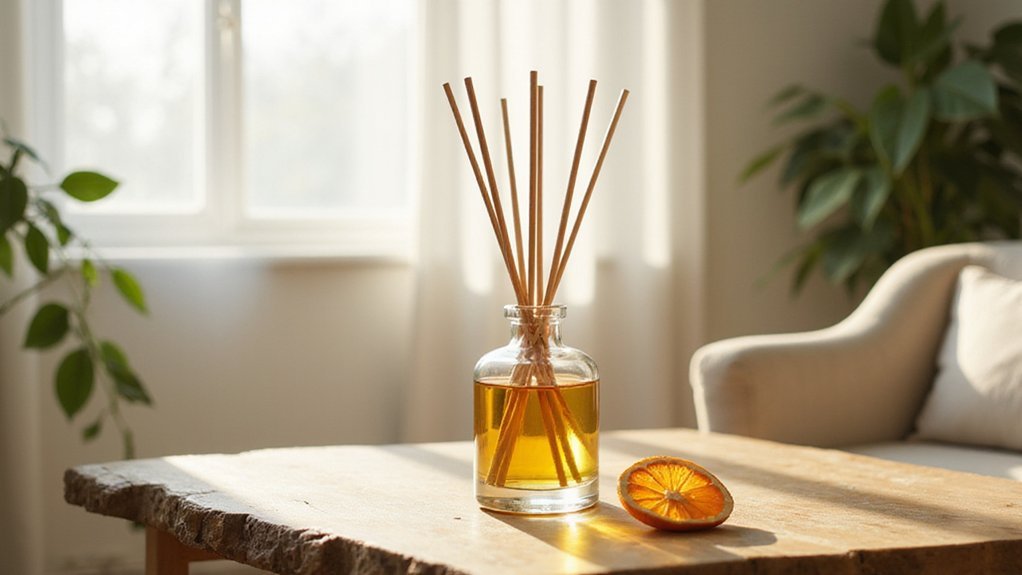
How Does a Reed Diffuser Work?
Ever wonder how a reed diffuser silently fills your space with fragrance? The secret lies in a simple physics trick that pulls scented oil up through sticks without any heat or electricity.
By the end of this, you’ll understand exactly how these elegant diffusers work and how to make theirs last longer.
Why Choose a Reed Diffuser Over Candles or Plug-Ins?
A reed diffuser is a safer alternative to candles or plug-ins because it requires no flame, heat, or electricity. You simply set it up and forget it, reducing fire risks—especially ideal for households with kids or pets. Unlike candles, there’s no smoke or soot, so your air stays cleaner. The diffuser continuously releases scent for four to eight weeks without any need to light a wick or manage wax. Your main task is flipping the reeds occasionally to refresh the aroma. Plus, their decorative glass and rattan design easily blends into any room, adding a stylish touch. Because there’s no energy consumption and no messy cleanup, reed diffusers are a low-hassle, cost-effective choice for everyday use. For those who also use humidifiers, routinely checking and replacing humidifier filter components helps maintain optimal air quality. Understanding how aromatherapy diffusers work can help you appreciate why the reed version requires so little maintenance. For similar low-maintenance cooling, many homeowners find that top window air conditioners provide efficient, set-and-forget comfort during hot weather.
How Capillary Action Draws Liquid Up Without a Pump
Capillary action draws liquid upward without a pump by utilizing microscopic channels inside the reed, such as rattan or bamboo, which act like tiny straws. When you insert the reeds into the fragrance oil bottle, adhesion forces the oil to stick to the walls of these channels. Meanwhile, cohesion, the attraction between liquid molecules, holds the oil together as it moves upward. This combined effect causes the liquid to rise against gravity without external energy. The porosity of the reeds is crucial; if the channels are too narrow or the oil is too thick, the upward flow slows down. Choosing an oil with the right viscosity ensures optimal capillary performance and consistent scent release. Once the oil reaches the tip of the reed, evaporation releases the scent into the air, and the cycle continues until the bottle is empty. Unlike electronic diffusers that rely on pumps or heat, reed diffusers operate solely through this passive capillary action. This passive design avoids the need for external energy or moving parts, making it inherently quieter and more energy-efficient.
How Rattan Reeds Boost Scent Strength
Rattan reeds provide stronger scent output because their open internal channels and high porosity allow fragrance oils to travel and evaporate more efficiently. The tubular structure of rattan, which resembles tiny straws bunched together, continuously channels the oil, boosting fragrance diffusion without the need for heat or flames. As a natural material, rattan’s porous cells readily absorb oil and release scent more quickly and evenly. Thicker reeds, around 3 mm in diameter, hold more oil and enhance scent strength further. To maximize performance, using 4 to 8 reeds increases the surface area for evaporation, intensifying the scent throw. Periodically flipping the reeds refreshes diffusion, but replacing them every six months prevents saturation from weakening the scent. While rattan handles most oils well, high-viscosity blends may slow absorption. Avoid placing the diffuser in direct sunlight to prevent the oil from degrading too quickly. For consistent scent output, consider regulating room temperature as cooler environments slow evaporation while warmer ones speed it up. Overall, the combination of open channels, porosity, and appropriate thickness ensures reliable, robust scent diffusion. These sticks are made from biodegradable, environmentally friendly rattan material, making them a sustainable choice for long-term use. For those seeking a quiet alternative to mechanical cooling, a reed diffuser can operate without the noise of a windowless air conditioner.
Why Oil-to-Base Ratio Controls Intensity and Lifespan
Getting the oil-to-base ratio right is crucial because it controls both the scent intensity and the lifespan of your diffuser liquid. An 80/20 base-to-oil blend offers a balanced approach, providing consistent diffusion without wasting oil. Higher fragrance loads, such as a 70/30 mix, make the scent noticeably stronger but also accelerate evaporation, leading to more frequent refills. For optimal wicking and diffusion, use a narrow neck container just like the ones recommended for candle or diffuser use. Unlike a humidifier, a reed diffuser requires no electricity or moving parts for operation, making it a passive scent delivery system. For similar moisture control, a dehumidifier can help keep centipedes out of your home by reducing the humidity they thrive in. This passive approach also means you avoid the higher energy consumption associated with powered air cleaning devices.
Too much oil can cause problems like thickening the liquid, clogging reeds, and impairing wicking. This results in dry tops and uneven scent release. Conversely, too little oil may produce a weak aroma and short-lived diffusion. Starting with an 80/20 ratio allows you to enjoy a reliable scent experience while maximizing your diffuser’s longevity.
For strong scents like peppermint, aim for 20–25% oil content, while softer fragrances may need less. Testing small batches first helps you find the perfect balance. Remember, you can always adjust upward if you want a more intense aroma, but reducing oil content later could sacrifice scent strength and diffusion duration.
How to Set Up a Reed Diffuser for Best Results
To achieve the best results with your reed diffuser, start by protecting your work surface with paper towels or an oil-safe barrier to prevent spills. Fill your vessel about halfway to three-quarters full with an 80/20 blend of base and oil, which ensures optimal diffusion without overcrowding. Before inserting the reeds, wipe the bottle neck clean to avoid accidental overflows during placement. Insert the reeds slowly, fan them out slightly to promote better air circulation, and wait approximately 10 minutes for the scent to start dispersing. Flip the reeds to jumpstart diffusion, but only do this every few days—frequent flipping can cause uneven scent spikes. This reversing process should be done with gentle handling to prevent oil spills. Replace the reeds when they become clogged or no longer absorb the oil effectively, ensuring consistent performance. For best results, use a soft brush to gently clean debris from the vessel’s interior before refilling, just as you would maintain a tower fan’s grille to prevent buildup. Correct placement is crucial, so position the diffuser away from drafty areas to avoid rapid evaporation and poor scent throw. Choose a vessel that complements your decor, preferably made of glass for durability and stain resistance, and position your diffuser in a central, high-traffic area away from direct sunlight or heat sources to maximize scent distribution.
How Evaporation Creates Steady, Room-Filling Scent
The evaporation cycle is what creates a steady, room-filling scent from your diffuser. Once set up, the process relies on passive evaporation, which continuously releases fragrance rather than producing fleeting bursts. Fragrance oil moves upward through the reed’s porous channels using capillary action, then slowly evaporates from the exposed tips. As scent molecules leave, more liquid is drawn upward, maintaining the flow. This self-sustaining loop results in a consistent, subtle background aroma rather than sudden spikes. The carrier base influences the rate of evaporation: thinner formulas evaporate faster but reduce the diffuser’s lifespan. Room temperature also plays a role—warmer air accelerates evaporation, while colder conditions slow it down. The outcome is a gentle, long-lasting scent that effortlessly permeates your space. A solvent like butil carbol is preferred because its thin, clear, and odorless consistency facilitates proper fragrance diffusion. For optimal performance, consider that smart thermostats can help maintain a stable room temperature to regulate the evaporation rate.
How Many Reeds Strengthens Your Diffuser’s Scent?
The number of reeds you choose directly impacts how strong your diffuser’s scent will be. Each reed acts as a wick, drawing fragrance oil into the air and dispersing it throughout the room. More reeds increase scent diffusion, creating a bolder, more noticeable aroma—ideal for larger spaces or when you want a more pronounced fragrance. Fewer reeds soften the aroma, making it suitable for smaller rooms or sensitive noses. Unlike an air purifier, which filters particles, a reed diffuser solely relies on passive evaporation to release fragrance into the air. For those with respiratory concerns, some devices like humidifier models can actively add moisture to aid breathing, unlike this passive method. In contrast, window air conditioners provide active cooling and can also help filter the air in a room.
A good starting point is to use 4 to 6 reeds for a small diffuser and 6 to 8 reeds for a medium-sized one. Add one reed at a time, then wait about 24 hours for the scent to stabilize. Flip the reeds weekly to refresh the throw and maintain an even scent. Keep in mind that using more reeds will accelerate oil consumption, so you might want to remove a few if the scent becomes too overpowering. Adjust the number gradually until you find the right balance for your space.
How Long Does a Reed Diffuser Last?
A reed diffuser typically lasts between 3 to 6 months with proper care. The lifespan depends on factors such as the size of the oil refill, the type of oil used, and environmental conditions. As the oil depletes, the scent gradually diminishes, and reeds may clog, reducing diffusion efficiency. Placing your diffuser in a cool, stable location away from direct sunlight and vents can help extend its life. When kept unopened, the oil usually stays fresh for 1 to 2 years, but once opened and in use, expect a steady fade over several months.
How Often to Flip Reeds for Maximum Lifespan
Flipping your reeds every 7 to 14 days is ideal for maintaining a consistent scent and prolonging your diffuser’s lifespan. In drafty areas like kitchens or bathrooms, switch the reeds weekly to prevent over-saturation, which can dull performance and cause oil to evaporate faster. In more stable environments such as bedrooms, stretching the interval to two weeks works well. You’ll recognize it’s time to flip them when the fragrance weakens or the reeds appear dusty or clogged. For spaces requiring consistent airflow, consider how different humidifier filter options can optimize the environment for your diffuser. This is because a diffuser relies on the principle of capillary action to draw oil upward, much like a wick draws water.
Treat flipping as a routine maintenance step rather than daily effort. Regularly flipping keeps the reeds fresh and the scent vibrant, but avoid overdoing it, as excessive flips can oversaturate the reeds, reducing their effectiveness and increasing oil consumption. If you notice the scent remaining weak even after flipping, it’s better to replace the reeds every 4 to 6 weeks for high-quality oils or every 2 to 3 months for standard fragrances. This careful approach ensures your diffuser remains effective while maximizing its overall lifespan.