What Is Reed Diffuser Oil and How Does It Work?
If you’re wondering how reed diffuser oil works to keep your space smelling fresh without candles or sprays, you’re not alone. This oil is specially formulated to slowly release scent through passive diffusion.
This process creates a continuous aroma in your room. Keep reading to learn exactly what makes reed diffuser oil work and how you can make it last longer.
What Is Reed Diffuser Oil?
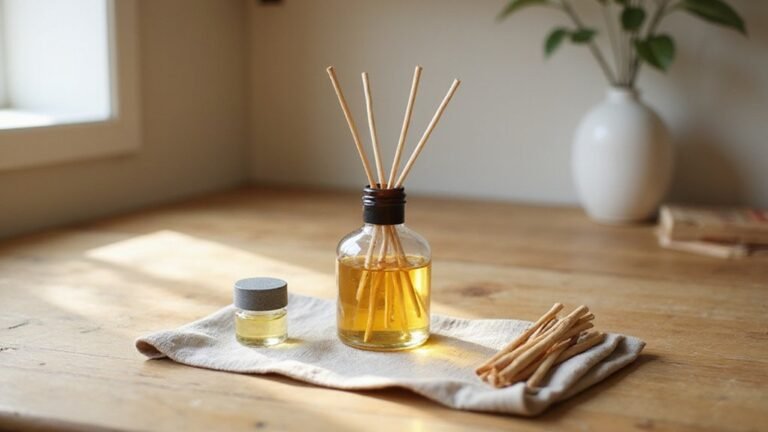
Reed diffuser oil is the scented liquid you pour into the bottle to fragrance a room. It serves as the aromatic core of the diffuser system. Typically, the oil blends essential or fragrance oils with a lightweight carrier such as fractionated coconut oil. A standard mixture includes around 70% carrier oil and 30% scent oils. This ratio ensures a steady release of fragrance over several weeks without becoming too thick to travel up the reeds. Unlike electric ultrasonic diffusers, which use water and vibrations to disperse oil, reed diffusers rely on passive capillary action through the reeds. For those seeking a different method, warm mist humidifiers use heat to evaporate water and oil blends into the air. When choosing a reed diffuser for a damp space, consider pairing it with a top air purifier for mold to actively improve air quality.
You usually choose reed diffuser oil based on your color preferences—clear or tinted formulas. Color doesn’t impact performance, but matching your decor might enhance the aesthetic. The oil is poured into a narrow-necked vessel designed to optimize absorption. Pair it with rattan reeds, which act as the wicks. The mixed oil travels up the reeds and continuously releases aroma into the room. Keep in mind that pure essential oils alone are too volatile and won’t work effectively, so they’re blended into the base oil to achieve desired scent longevity and consistency.
The Science Behind How Reed Diffusers Work
Reed diffusers work through a combination of three physical processes that function without any heat input. First, capillary action pulls the scented liquid upward through the tiny, microscopic channels in the reeds. This process depends on the porosity of the reeds and the availability of liquid; as long as these conditions are met, the liquid continuously moves upward. Next, evaporation occurs at the exposed tips of the reeds, releasing fragrance molecules into the air. This passive process happens naturally and requires no external energy. Finally, diffusion disperses the fragrance molecules from areas of higher concentration within the room to lower concentration zones, gradually spreading the scent evenly throughout your space. You can control the intensity of the aroma by adjusting the number of reeds—adding more increases the surface area and accelerates evaporation. Unlike some space heaters, reed diffusers pose no carbon monoxide risk because they rely solely on passive physical processes rather than combustion. Similar to optimizing a fan’s performance, ensuring the reeds are properly positioned and unobstructed can improve airflow and scent distribution. To ensure consistent scent release and long-lasting performance, choose a carrier liquid formulated to wick smoothly without clogging or clogging, maintaining reliable diffusion over time. The careful selection of carrier liquid viscosity is critical to achieving a steady wicking rate and preventing premature evaporation.
Why Standard Fragrance Oil Won’t Wick Through Reeds
Standard fragrance oils are too viscous to wick effectively through reed diffusers. Their heavy base oils, like vegetable or jojoba oil, create internal resistance that prevents capillary action. As a result, the liquid cannot climb up the reeds, leaving you with weak or uneven scent diffusion. Typically, these oils are loaded at around 25% fragrance load, which can clog the porous channels, while a safer range of 15–20% helps keep the oil mobile. Unlike essential oil cool mist humidifiers that actively disperse fragrance through a mechanical process, reed diffusers rely entirely on passive wicking.
Heavy or resinous components such as patchouli or amber also inhibit proper wetting because they tend to stay at the base rather than traveling to the tips of the reeds. This means the reeds only saturate near the bottom, reducing the scent throw and causing clogging over time. Additionally, standard oils lack temperature stability, so they thicken or separate in cooler environments, impacting wick performance. Their limited shelf life is also an issue, as residue buildup from oxidation accelerates deterioration. In contrast, an air circulator uses a different mechanism to move air efficiently without relying on wicking performance at all. To maintain proper wicking, you need a fragrance oil formulation with a thinner, lighter consistency that remains stable and mobile over time, much like the cooling efficiency ratings that guide air conditioner performance.
Typical Ingredients in a Reed Diffuser Oil Blend
A reed diffuser blend typically consists of three main components: fragrance oils, carrier oils, and alcohol. You start with essential oil blends that include top, middle, and base notes to create a balanced scent profile. Popular choices are lavender, cedarwood, and citrus, which work together to enhance both throw and longevity. Understanding how essential oil diffusers work can help you select the right diffusion method for your space.
The carrier oil is critical because it influences how quickly the scent disperses. Light carrier oils like fractionated coconut, safflower, or sunflower are preferred because they are less viscous, allowing the fragrance to wick faster into the reeds. The ratio of carrier oil to alcohol and fragrance oil is also important; a common blend uses around 70 percent carrier oil, 10 percent high-proof alcohol, and 20 percent essential oils. This balance ensures a steady scent movement without oversaturating the reeds or having the fragrance burn out too quickly. For optimal plant humidity control, a similar principle of balanced diffusion applies when choosing the best humidifier for Calathea. The same concept of air movement efficiency matters in a ceiling fan bedroom to ensure consistent circulation without creating drafts.
What the Carrier Base Actually Does for Your Diffuser
The carrier base is your diffuser’s delivery medium — it’s the liquid that transports fragrance from the bottle into the reeds and ultimately into the air. Its primary role isn’t just to carry scent; it also determines how well that scent performs over time. Viscosity, or thickness, is key here. A low-viscosity, thin base allows the liquid to wick up the reeds smoothly and consistently, ensuring a steady release of aroma. Thick oils can clog the reeds and hinder fragrance flow, leading to uneven scent distribution or faster degradation. Unlike air conditioners where running cost can vary greatly between portable and window units, the carrier base in a diffuser directly influences the cost-effectiveness of your fragrance experience over time.
Choosing the right carrier base affects your diffuser’s longevity and scent quality. A well-matched, lightweight base ensures a gradual, even scent flow that prevents abrupt peaks and maintains a balanced fragrance over days or weeks. Conversely, an incompatible base may cause clogging, weaken performance, and significantly shorten the diffuser’s lifespan. Remember, the base may be silent but it plays a vital role in your diffuser’s consistent and long-lasting operation.
How Capillary Action Moves Reed Diffuser Oil Up the Stick
Capillary action moves reed diffuser oil up the stick through the combined effects of surface tension and adhesion. The oil clings to the reed’s walls via adhesion, while cohesion pulls additional liquid upward behind it. The microscopic channels within the rattan wick continuously wick the oil, gradually saturating the entire stick. As the oil evaporates from the tip, fresh oil from below rises to replace it, maintaining a constant, passive cycle. You may notice color variations in your diffuser oil; these do not affect the wicking process but indicate the need for reed maintenance. To ensure unobstructed pores, flip the reeds periodically, which helps refresh evaporation and keeps capillary action functioning smoothly, similar to proper ventilation in a dehumidifier for sustained performance. Dust and debris can clog pores, so regular cleaning is essential for consistent diffusion. Regularly using a soft brush can help clear dust from the reed pores and prevent buildup, similar to maintaining a fan’s grille. Selecting a compatible fragrance oil ensures the rattan wicks do not become oversaturated with heavy synthetic ingredients.
5 Factors That Control Reed Diffuser Oil Scent Strength
Several key factors influence how strong your reed diffuser’s scent will be, and most of them can be adjusted easily. The quality of the fragrance oil is fundamental; higher-quality, less diluted blends saturate the reeds more effectively, resulting in a stronger scent. Conversely, over-diluted oils produce a weaker aroma. The number and type of reeds also matter—adding more reeds or using fiber reeds can boost scent intensity, but replacing old or clogged reeds is essential, as they reduce performance. Room size impacts how scent is perceived: small, enclosed spaces concentrate the aroma, making it seem stronger, while larger, open areas dilute it. Airflow increases evaporation, so placing your diffuser in a spot with gentle airflow enhances scent dispersal, but avoid vents or radiators that can speed up evaporation and reduce oil lifespan. Warm temperatures temporarily strengthen the scent but also cause faster evaporation, shortening the diffuser’s overall longevity. To keep the scent consistent, flip your reeds weekly; this refreshes the surface and maintains a steady fragrance strength.
How to Get the Most Out of Your Reed Diffuser
To get the most out of your reed diffuser, focus on setup, placement, and regular upkeep. First, remove the seal carefully and wipe the bottle neck to prevent debris from clogging the reeds or affecting scent dispersal. Use only rattan reeds, as they are designed to absorb and release fragrance efficiently. Let the reeds soak in the oil for a few hours before flipping them to kickstart the scent throw.
Position your diffuser in a high-traffic area on a central surface, but keep it away from direct sunlight and vents. This placement ensures steady airflow and prevents the oil from evaporating too quickly, similar to how a tower fan optimizes air movement in a room. Adjust the number of reeds based on your desired scent strength—three to five for a subtle aroma, or six to eight for a more noticeable fragrance. Flip the reeds weekly to maintain scent intensity or less often if you prefer a lighter scent profile. For best results, also keep your diffuser in a room with optimal humidity levels to prevent the oil from drying out too fast and to enhance scent distribution.
Wipe the bottle neck periodically to prevent buildup or clogging, which can diminish scent output. If you’re experimenting with color mixing, choose reeds that complement your artistic display and avoid clashing colors. Replace reeds when they become clogged or the fragrance weakens noticeably. To keep your diffuser performing consistently, refill the oil before it runs dry.
Reed Diffusers vs. Candles and Plug-Ins: Which Is Better?
Reed diffusers are safer than candles and plug-ins because they do not require an open flame, heat source, or electricity. Without a flame or electrical components, there is no fire risk, soot production, or need for constant supervision. Candles involve an open flame that can accidentally cause fires if left unattended, while plug-ins depend on electrical currents and heating elements that can malfunction or pose fire hazards. Unlike these devices, a reed diffuser also avoids the health risks associated with mold growth in humid environments by not adding moisture to the air. In contrast, electrical heaters pose fire and burn risks when placed near flammable materials or used with damaged cords.
Environmentally, reed diffusers also come out ahead. They operate without electricity, produce no wax drips or plastic cartridges, and work through capillary action. Candles burn wax and release soot, contributing to indoor pollution. Plug-ins consume power continuously and need disposable refill cartridges, creating waste.
They provide a continuous, gentle fragrance without fire hazards or energy consumption concerns. If safety, environmental impact, and low maintenance are priorities for you, a reed diffuser is the better choice over candles and plug-ins.
5 Mistakes That Kill Your Reed Diffuser’s Performance
Even the best reed diffuser oil won’t perform well if you make common mistakes. First, avoid placing your diffuser in direct sunlight or near heat vents; rapid evaporation speeds up oil loss and reduces scent longevity. Second, don’t overload with reeds—using too many can actually harm diffusion by trapping air and clogging reeds, which decreases the scent output. Third, flip the reeds every 7 to 14 days; doing so allows fresh scent to circulate while flipping too often can drain the oil faster, and not flipping enough can cause clogs. Fourth, use diffuser oil designed specifically for reed diffusers—thick liquids or household oils can clog the reeds and stop the diffusion process altogether. Finally, keep your diffuser clean by regularly dusting the reeds and replacing old, darkened oil to maintain optimal performance. For a consistent scent, always refill diffuser oil before it completely runs out to avoid uneven dispersal. When buying refills, consider color options and gift packaging, but always prioritize proper care to ensure your diffuser works its best.