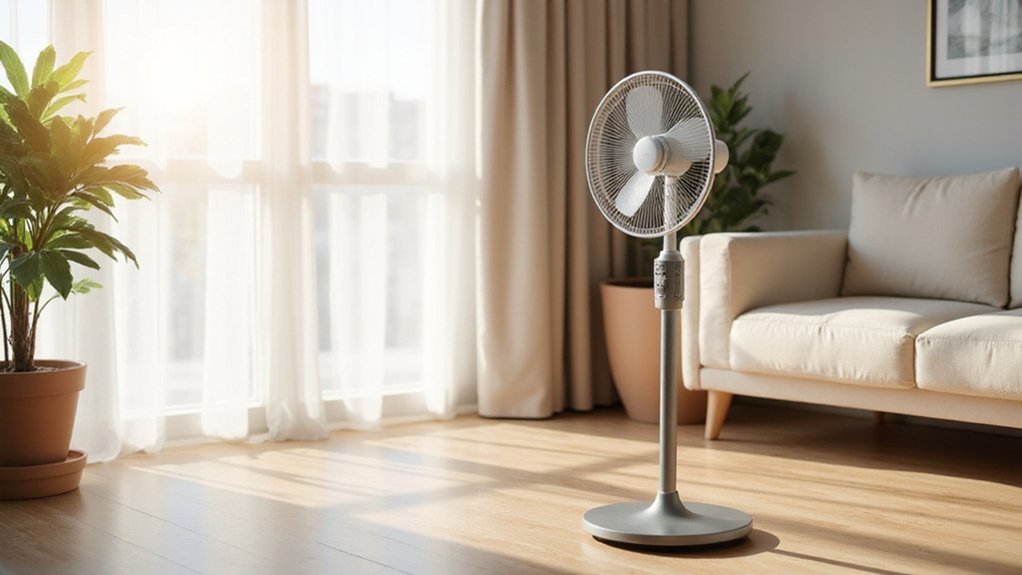
Oscillating Fan vs Regular Fan: Which Is Better?
Wondering whether an oscillating fan or a regular fan is better for your space? The choice mainly depends on the size of your room and how broadly you want the air to circulate.
An oscillating fan can cool larger areas evenly, while a fixed fan provides stronger, direct airflow for quick relief in a specific spot.
Here’s everything you need to know to make the right call.
What Makes an Oscillating Fan Different From a Regular Fan?
An oscillating fan differs from a regular fan mainly because it moves its head side to side to distribute air across a wider area. A regular fan, on the other hand, stays fixed in one position, blowing air directly in one direction. The design of a regular fan is simpler, featuring fewer moving parts, which makes it easier to maintain and potentially more durable. Conversely, an oscillating fan incorporates a gear or cam system that enables the sweeping motion, adding complexity to its construction. This sweeping motion is achieved through a four-bar mechanism that transforms the motor’s rotation into oscillation. Many modern oscillating fans also use filtration technology to capture airborne particles while circulating air. For effective moisture control, a bedroom dehumidifier often relies on compressor-based technology to remove excess humidity from the air. This design differs from bladeless fan technology, which uses an air multiplier to create a more consistent airflow without visible moving blades.
This movement impacts how energy is used. Although a regular fan might seem more efficient because it has fewer components, an oscillating fan can actually save energy by circulating air over a larger space. By doing so, you can often run the oscillating fan at a lower speed to achieve the same cooling effect. This wider coverage helps eliminate hot spots, promoting a more even temperature distribution in the room, and can lead to energy savings over time.

Ideal for Bedrooms, Where Design Meets Safety: This 19-inch enclosed ceiling fan is more than a cooling device—it's a sleek white accent for bedrooms, studies, or closets. Its bladeless, enclosed design eliminates exposed blade risks, making it a safe choice for homes with kids or pets. Enjoy pure, worry-free comfort in any small space
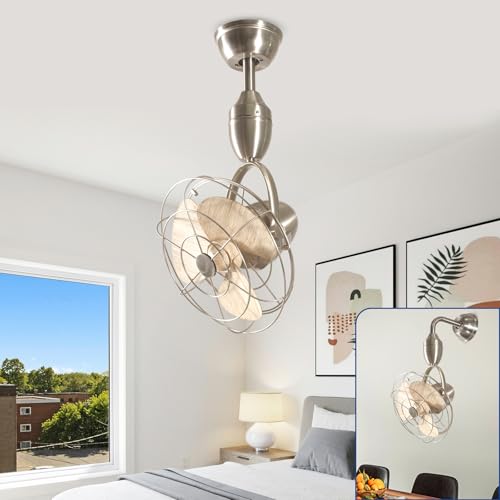
Sleek Design, Elevate Your Style: This oscillating ceiling fan with remote features high-quality ABS blades and a blend of modern and classic design elements. It’s not just a functional appliance but also a stylish addition to your home decor. Whether installed in the patio, bedroom, or kitchen, it seamlessly integrates into any environment, enhancing the overall aesthetic and comfort of your space

Sleek Design, Elevate Your Style: This oscillating ceiling fan with remote features high-quality ABS blades and a blend of modern and classic design elements. It’s not just a functional appliance but also a stylish addition to your home decor. Whether installed in the patio, bedroom, or kitchen, it seamlessly integrates into any environment, enhancing the overall aesthetic and comfort of your space
When Is an Oscillating Fan the Better Choice for Your Room?
An oscillating fan is the better choice for your room when you want to cool a larger area rather than just a single point. Its side-to-side motion helps distribute air evenly across the entire space, making the room feel cooler and more comfortable for everyone inside. This is especially useful if you have multiple people sharing the room, as it prevents hot spots and uneven airflow. In stuffy or stagnant rooms, the continuous air circulation reduces that oppressive, muggy feeling without needing complex systems—just turn on the fan. For even better coverage, consider pairing it with one of the best window air conditioners to enhance cooling throughout the room. Unlike central heating, which can be costly to run for a single room, an oscillating fan offers a more energy-efficient solution for localized cooling. For optimal air quality, using an oscillating fan alongside a humidifier with distilled water prevents white dust buildup in the room.
An oscillating fan works well alongside your air conditioner, helping spread the cool air to every corner of the room. Modern models often feature sleek, unobtrusive designs that blend into your decor and operate quietly so they won’t disturb conversations or sleep. Because of their broad coverage and gentle, continuous breeze, oscillating fans are ideal for maintaining consistent comfort in shared or larger spaces, unlike static fans that blow air in a single direction or at a fixed point.
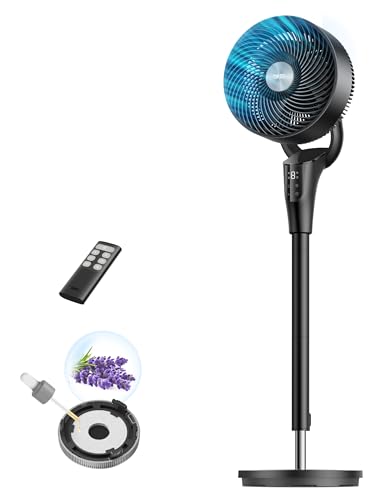
𝙐𝙡𝙩𝙧𝙖 𝙋𝙤𝙬𝙚𝙧𝙛𝙪𝙡 𝘼𝙞𝙧 𝘾𝙞𝙧𝙘𝙪𝙡𝙖𝙩𝙤𝙧 𝘽𝙮 𝙐𝙥𝙜𝙧𝙖𝙙𝙚𝙙: Compared with previous DREO fan for bedroom, the 2026 upgraded air circulator fan for whole room powered by DREO's advanced airflow tech circulates air up to 90 ft away and 1000 CFM to circulate all the air in your bedroom, living or kitchen in under 2 min. (DR-HPF013, TurboPoly Fan 353)

𝑷𝒐𝒘𝒆𝒓𝒇𝒖𝒍 𝒂𝒊𝒓𝒇𝒍𝒐𝒘 𝒇𝒐𝒓 𝒇𝒂𝒔𝒕 𝒄𝒐𝒎𝒇𝒐𝒓𝒕: With a 26ft/s air speed, this tower fan blows cold air, providing refreshing breezes to chill your space quickly. Perfect for hot summer days or stuffy indoor areas.

𝗢𝗻𝗲 𝗙𝗮𝗻 𝗳𝗼𝗿 𝗔𝗹𝗹 𝗬𝗼𝘂𝗿 𝗡𝗲𝗲𝗱𝘀: From a gentle breeze to a powerful wind, it adapts to your everyday needs with up to 28 ft/s airflow and a wide oscillation angle to deliver fast, whole-room cooling
What Situations Favor a Regular Fan Over an Oscillating Fan?
A regular fan is preferable over an oscillating fan when you need targeted, focused airflow for personal comfort or specific small areas. Because it directs a strong, direct stream of air straight at you or into a particular spot, it’s ideal for personal desks, bedside tables, or individual workstations. In environments like kitchens or laundry rooms, a fixed fan’s direct airflow helps offset localized heat from appliances without disturbing other areas. For pet owners dealing with allergens, a regular fan can help direct cleaner air toward a specific zone where a cat sheds dander, avoiding the spread of particles to the entire room. Outdoors, a stationary fan provides a consistent breeze that is more effective than oscillation for maintaining a steady flow of air in open spaces. Additionally, regular fans tend to be quieter due to their simpler construction with fewer moving parts. Their straightforward design also makes it easier to position them precisely, which is valuable when you want immediate relief or have limited space. This targeted cooling approach makes a regular fan ideal for environments needing focused airflow here compared to oscillating models. Unlike space heaters, which can pose carbon monoxide risks if not properly ventilated, regular fans rely on simple mechanical movement with no combustion hazards. When comparing models for stationary use, a regular fan often offers a better performance and running cost balance than a pedestal fan that rotates.

【Powerful and Customizable Cooling】Stay cool and comfortable with the tower fan, designed to deliver rapid airflow up to 24ft/s for instant relief from heat. This oscillating fan features three speed settings to match your cooling needs, whether you're working or sleeping. As a versatile standing fan, it’s perfect for any room, from bedrooms to offices and dorms. Whether you need a desk fan, table fan, or floor fan, this cooling fan ensures a breeze wherever you need it.Ideal as a fan for bedroom, it creates a cool atmosphere for restful sleep

Honeywell Quality: Help improve cooling and energy savings* throughout the indoors from living room to bedroom with a Honeywell tower fan; choose from tower fans to personal portable fans and whole room fans that are all a great choice

𝑾𝒉𝒐𝒍𝒆-𝒓𝒐𝒐𝒎 𝑨𝒊𝒓𝒇𝒍𝒐𝒘 𝑷𝒐𝒘𝒆𝒓: TurboWind tech ensures whole-room circulation, delivers up to 950 CFM airflow and sends air up to 85 ft, cooling room in 1 min, ideal for home or office(TurboPolyTM Table Fan 565S). Product Dimensions: 9.45"D x 9.45"W x 12.2"H, Blade Diameter: 7"
Why an Oscillating Fan Distributes Air Better Than a Fixed Fan
An oscillating fan distributes air more effectively across a room compared to a fixed fan. Its side-to-side sweeping motion covers a much wider area, preventing the concentrated, direct airflow typical of fixed models. As the fan mechanism constantly shifts direction, it eliminates dead zones that often remain untouched by stationary fans. This movement breaks up stagnant air pockets and cools hot spots in corners, leading to more uniform temperature distribution. The gentle, oscillating breeze also feels more natural and comfortable than a harsh, direct blast. Because the airflow its shifting patterns create mix warm and cool air more thoroughly, it pushes conditioned air further into the room. This convection process helps stabilize the temperature without needing to reposition the fan frequently. Overall, the dynamic airflow generated by an oscillating fan results in an evenly cooled, more comfortable space, making it a superior choice for whole-room air circulation. This consistent air movement is similar to how a baby humidifier prevents stagnant zones by dispersing moisture evenly throughout a nursery. This approach is especially beneficial for calathea plants that require high humidity to thrive. Using an oscillating fan can also be more energy efficient than running multiple fixed fans.

𝐅𝐚𝐬𝐭𝐞𝐫, 𝐈𝐧𝐬𝐭𝐚𝐧𝐭 𝐑𝐞𝐥𝐢𝐞𝐟:Powered by a new 1580RPM DC motor, this tower fan reaches up to 28 ft/s speed with 1473 CFM airflow. Refreshing living rooms, bedrooms, and home offices the moment you turn it on.

New and improved! New quieter motor, new modern sleek design, new capacitive touch display, backlit display, dimmable sleep mode. Same supreme motor with 8 levels of quiet power.

Cool anywhere you go: Powered by TurboSilent and a unique airfoil design, this air circulator fan blasts cool air up to 65ft away with a strong 750 CFM airflow, delivering cool air for your whole room, regardless of the size. Beat the heat, DREO makes you comfortable at large.(Fan Diameter: 11" Height, 6" Blade). (Product Dimensions: 10.71"D x 8.35"W x 11.81"H)
Does Oscillation Increase Electricity Usage Compared to a Stationary Fan?
Oscillation’s impact on your electricity bill is minimal. Power measurements reveal no significant increase in wattage when you turn on oscillation compared to leaving the fan stationary. A typical 50W fan consumes about 44W whether oscillating or not, so the cost difference is negligible. Since these fans often run for several hours, the extra energy used by oscillation hardly affects your overall bill. In fact, oscillation can help cool a larger area more efficiently, allowing you to turn off the fan sooner and potentially save energy. Noise levels stay consistent whether oscillating or stationary, so you won’t sacrifice comfort for savings. For targeted relief, a humidifier for cough can also soothe irritated airways. To further maximize efficiency, you can also apply smart thermostat placement tips to optimize your home’s overall climate control. Selecting a premium thermostat like an ecobee can further automate temperature management to reduce overall energy use. Ultimately, focusing on size, speed setting, and how long you run the fan has a much greater impact on electricity use than whether it oscillates.
Why a Fixed Fan Cools You Faster Up Close
A fixed fan cools you faster up close because its continuous, concentrated airflow directly targets your body without dispersing. When you stand near a stationary fan, the breeze hits your skin with high velocity, removing warm air layers—called boundary layers—more effectively. This helps lower your skin’s temperature quickly through convection and enhances sweat evaporation. Unlike a fixed fan, reed diffusers rely on passive capillary action to disperse fragrance, not concentrated airflow. For effective water damage restoration, a similar principle applies where dehumidifiers use concentrated airflow to quickly dry out affected areas. At close range, the airflow remains stronger and more stable, resulting in a cooling effect about twice as effective as from a fan placed two meters away. Tests with thermal mannequins show a fixed fan can produce roughly a −2 °C temperature reduction at one meter, compared to about −1 °C at two meters. For tower fans, regular cleaning with a soft brush prevents mold and buildup that can block airflow. Oscillating fans, on the other hand, shift the breeze away repeatedly, reducing the direct, focused airflow and limiting cooling strength.
For the fastest, most personal relief, a stationary fan aimed directly at you outperforms oscillating models. Its unbroken stream works more efficiently at removing heat from your skin and accelerating evaporation, offering quicker comfort.
Which Fan Keeps Multiple People Comfortable in the Same Space?
A fan that oscillates keeps multiple people comfortable in the same space. Unlike a fixed fan that directs airflow in one concentrated direction, oscillating fans spread air side to side, covering a broader area. This reduces hot spots and ensures everyone receives airflow, not just those directly in front of the fan. You won’t need to reposition the fan as people move around, making it ideal for shared rooms, offices, or living spaces. Many oscillating models also come in a variety of colors to match your decor, and they tend to operate quietly, maintaining a peaceful environment. In contrast, stationary fans may leave some occupants outside the strongest airflow, resulting in uneven comfort. For group settings, oscillating fans are the best choice because they provide consistent cooling for everyone in the room. For whole-home comfort, a whole house humidifier can also help maintain balanced humidity levels throughout the space.
How to Choose a Fan Based on Room Size, Layout, and Goals
To select the right fan for your room, start by measuring the space accurately. Square footage determines the ideal blade span and airflow you need. For rooms smaller than 75 square feet, a fan with a blade span of 29 to 36 inches is sufficient to circulate air effectively. Medium-sized rooms up to 225 square feet benefit from fans with blades measuring 36 to 50 inches. Larger areas may require fans with blades 50 to 54 inches or multiple fans to ensure proper airflow.
Ceiling height is also crucial; blades should hang 7 to 9 feet above the floor to maximize efficiency and safety. A remote control can keep airflow and oscillation adjustments at your fingertips without getting up. To match your fan to your room’s size, consider the CFM (cubic feet per minute) rating—oversized fans waste power, while undersized fans won’t circulate air well. For spaces where smoke is a concern, a fan alone cannot replace the need for a HEPA air purifier to capture airborne particles.
If space is tight, opt for a tower or wall-mounted fan to save floor area. For broader coverage or whole-room comfort, a properly sized ceiling or pedestal fan is best, providing consistent airflow without placing strain on the device or your energy bill.

32-INCH TOWER DESIGN: Ultra-slim profile provides effective air circulation while saving valuable floor space in your home or office.

COMMERCIAL GRADE: 30-inch diameter fan blade designed for industrial and commercial applications with durable construction for long-lasting performance.

𝙄𝙣𝙩𝙤 𝒕𝒉𝒆 𝙒𝙤𝙧𝙡𝙙 𝙤𝙛 𝙒𝙞𝙣𝙙: Optimized air outlets and ultra-wide 120-degree cooling enable DREO Tower Fan 714S for bedroom to circulate mind-blowing cool around the whole room at high speeds as fast as 28 ft/s