Are Reed Diffusers Safe?
Wondering if reed diffusers are safe to use around your home? They’re generally safer than candles since they don’t have an open flame, but they still come with risks.
Chemical solvents and fragrances can irritate your skin, eyes, or lungs. Spilled liquid can be dangerous if swallowed, especially for kids and pets.
Keep reading to learn how to choose and use reed diffusers more safely.
What’s Inside Most Reed Diffuser Bottles?
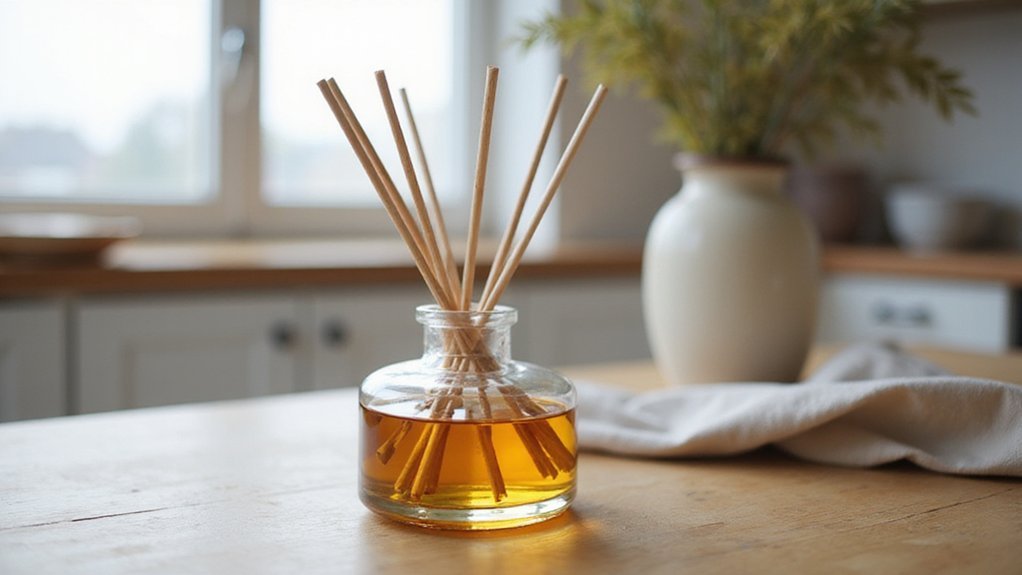
Most reed diffuser bottles contain a fragrance oil blend that is designed to release scent into the air gradually. The main ingredients are typically a diffuser base oil, such as fractionated coconut oil or sweet almond oil, which serve as carriers for the fragrance. Solvents like dipropylene glycol (DPG) or alcohol are added to thin the mixture, ensuring it wicks properly up the reeds. Many products utilize synthetic fragrance oils, although some use natural essential oils. Labels often mention “DPG-free” and “alcohol-free” to indicate alternative formulations. Regarding container materials, nearly all are made of glass because it resists reactions with the oils and maintains scent integrity. Plastics are generally avoided as they can degrade over time. However, ingredient transparency varies; some bottles list only “fragrance,” leaving you uncertain about the specific components inside. A key safety factor is that the fragrance load should not exceed the recommended percentage for the diffuser base to prevent irritation or evaporation issues. Using an air quality monitor can help detect any hidden mold issues that may be worsened by prolonged exposure to artificial scents in poorly ventilated spaces. For those concerned about overall indoor comfort, choosing a reed diffuser with a consistent scent release is similar to how top window air conditioner picks emphasize steady cooling performance.

Our Reed Diffuser Base transforms fragrance and essential oils into reed diffuser oils. It thins fragrance and essential oils so they flow up the reed easily and provide a bigger scent payoff. Many of our fragrance and essential oils are safe for use in reed diffusers.

UNSCENTED REED DIFFUSER BASE: High-quality reed diffuser base unscented, designed to carry fragrance without altering scent profiles. Ideal diffuser base for consistent, clean scent throw.

【Perfect Replacement】Our 20-pack of essential oil diffuser sticks measures 10 inches in length and 3mm in diameter, making them ideal for use in home reed diffusers, ensuring a continuous release of delightful fragrances.
Are Reed Diffusers Safer Than Candles or Wax Melts?
Reed diffusers are generally safer than candles because they do not involve open flames or combustion. Candles require constant supervision since an unattended flame can ignite nearby materials, posing a fire risk. In contrast, reed diffusers operate without flames; they release fragrance through natural evaporation, eliminating the danger of fire caused by accidental knocking over or forgetting to extinguish.
While candles produce soot and VOCs from burning, reed diffusers do emit VOCs as well but avoid combustion pollutants. Safety regulations for candles focus on fire hazards, whereas diffusers are considered safer for indoor air quality because they do not involve an open flame. For households with children or pets, diffusers reduce burn and knock-over risks significantly, making them a safer, more convenient option for continuous use. Correct placement away from heat sources and drafts maximizes their efficiency and safety, as per installation guidelines for similar air-moving appliances. Using a dehumidifier for centipedes can further reduce moisture that attracts pests.
However, it is important to note that diffusers still contain liquids that could spill or cause skin irritation if mishandled. Overall, you trade the potential of a flame hazard for a liquid-related one, but avoiding open flames makes reed diffusers the safer choice for maintaining fire safety in your home.

FRAGRANCE-INFUSED REEDS: Bath & Body Works Fragrance-Infused Liquidless Reeds are a scented reed diffuser that offers spill-free, flameless home fragrance with no liquids and no mess

REED DIFFUSER - Housed in a reusable, refillable glass vessel, our Reed Diffuser elevates everyday living and entertaining. It includes eight all-natural rattan reed sticks, delivering continuous fragrance, uninterrupted.

Chance-Inspired Blooming Scent – Inspired by the iconic floral-aldehyde spirit, this diffuser releases an airy bouquet of fresh florals and sun-kissed fruits—transforming any room into a radiant, optimistic sanctuary.
What Happens If Someone Swallows Diffuser Oil?
Swallowing diffuser oil can cause serious health issues, even at small quantities. The effects range from mild irritation to potentially life-threatening poisoning. This is because diffuser oils often contain high concentrations of toxic substances, such as up to 70% isopropyl alcohol and potent essential oils like lavender or eucalyptus. Immediately after ingestion, you may notice symptoms like mouth and stomach irritation, nausea, vomiting, and extreme drowsiness. In more severe cases, tremors or seizures can occur. This rapid onset of symptoms parallels how a window air conditioner uses a compressor to quickly circulate refrigerant and change temperatures. For safe use, these portable AC units often require a proper window venting kit to exhaust hot air outside. Similarly, using a humidifier for blocked nose can provide safe and effective relief without the ingestion risks associated with essential oils.
It is crucial not to induce vomiting, as this can increase the risk of aspiration into your lungs, leading to chemical pneumonia. Instead, if the person is awake, rinse their mouth thoroughly. Call Poison Control at 1-800-222-1222 for guidance. If breathing becomes difficult, seizures develop, or the person becomes severely drowsy, seek emergency medical help right away. Keep the diffuser bottle nearby to assist responders in identifying the product involved.
Can Reed Diffusers Irritate Your Skin, Eyes, or Lungs?
Reed diffuser oils can irritate your skin, eyes, or lungs if you come into direct contact with them. Spills can cause skin sensitivity, leading to rashes or allergic contact dermatitis. Safety data sheets classify these oils as skin irritants and sensitizers. If oil splashes into your eyes, you may experience pain and conjunctivitis; rinse with running water for at least 15 minutes.
Respiratory hazards occur when you inhale strong fragrance vapors. You might feel throat or airway irritation, especially if you are sensitive to fragrances. Poor ventilation makes this worse, increasing discomfort or causing difficulty breathing. While serious health issues are rare, direct contact and inhalation can pose risks to your skin, eyes, and lungs. Always wash off spills immediately and ensure good airflow to reduce irritation.
Why Kids and Pets Face Higher Risks From Reed Diffusers
Kids and pets face significantly higher risks from reed diffusers because they explore their environment with their mouths. Swallowing even a small amount of the liquid can lead to poisoning, drowsiness, or seizures. Toddlers are especially vulnerable because they often taste or handle bottles out of curiosity. Pets, with their smaller bodies, are more easily affected by chemical exposure, making ingestion and contact more dangerous. Cats are at particular risk because they lack certain liver enzymes needed to process essential oils, which can lead to rapid toxin buildup. Even vapor in the air can harm birds and small animals, who are more sensitive to airborne chemicals. Be mindful of spills or residues at floor level, as children or pets can lick, touch, or step in them, quickly turning a minor leak into a health emergency. For comparison, humidifiers for throat mucus relief offer a safer way to manage respiratory comfort without these chemical risks.

Oil Uses: Designed for but not limited to candle scents for candle making (especially works well with soy wax candle making), diffuser oil scents, freshie scents, oils for laundry, soap making supplies, slime scents, oils for skin, perfume oil, bath and body formulations, bath bombs, and many more essential DIYs.

Description - This luxurious fragrance is inspired by the signature scent of an iconic New York luxury hotel—known for its crystal-clear elegance, timeless sophistication and warm opulence. It features notes of sandalwood, cedar, jasmine, musk, ambergris, iris, orchid and bergamot.

SANTAL — The original Santal home scent, and our most iconic fragrance. Creamy Australian sandalwood with warm amber, papyrus, and dry woods — smooth, modern, and quietly confident. The luxury hotel scent, now for your home.
How to Childproof and Pet-Proof Your Reed Diffuser
To childproof and pet-proof your reed diffuser, place it on a high, stable shelf or an elevated unit that’s completely out of reach and out of sight. Avoid placing it in cribs, play areas, pet beds, or zones with high traffic where accidental knocks are more likely. Use childproof locks on cabinets that store additional oil or reeds, treating these compartments like household chemicals. Opt for containers with narrow necks or sealed designs to minimize spill risks and difficulty in reaching the contents. Always check product labels for warnings such as “keep out of reach of children and pets.” Choose non-toxic, phthalate-free options only when full ingredient disclosure is available to lessen health concerns if accidental exposure occurs. Keep your diffuser on a stable, tip-proof surface that is away from edges and open windows to prevent falls or spills. Use the diffuser in well-ventilated rooms and limit its run time to 4 to 6 hours per day. Regularly monitor for irritation symptoms and replace any damaged or unstable bottles immediately to ensure safety. Unlike systems that use compressor-based cooling to actively dehumidify air, reed diffusers work passively with volatile oils, so proper placement away from moisture sources is essential. Just as with space heaters, always follow manufacturer safety guidelines to prevent fire hazards and accidental burns. For optimal indoor air quality, a bedroom dehumidifier can actively control humidity levels to reduce mold and allergens, addressing moisture that reed diffusers leave untouched.

Pack & Exact Dual-Unit Dimensions: This product includes 1 piece of 150ml/5oz glossy blue glass diffuser bottle. The bottle measures 10cm/3.93inch in total height and 6.8cm/2.68inch in width, with a 1.8cm/0.7inch round bottle mouth, perfectly fitting most reed diffuser sticks for daily use

Size:11cm x 8cm.Package:1 x empty diffuser bottle.

Use Thicken glass material, exquisite appearance, environmental friendly, sturdy, durable, solid, heavy bottom
First Aid Steps for Accidental Diffuser Exposure
If you or someone else is accidentally exposed to diffuser oil, quick and accurate first aid is essential. For inhalation risks, move the person to fresh air immediately to prevent respiratory distress. Keep them calm, loosen tight clothing, and ensure they stay warm and at rest. Call emergency services (911) if breathing becomes difficult or irregular.
For chemical burns on the skin, remove contaminated clothing immediately and rinse the affected area with cool water for at least 15 minutes to dilute and wash away the irritant. Do not apply ointments, powders, or any remedies, as these can worsen the injury. Following correct diffuser use guidelines can help prevent such exposure in the first place.
In cases of eye exposure, flush the eye with lukewarm water continuously for 20 minutes. If the person can remove contact lenses easily, do so before rinsing. Avoid rubbing the eye, which can cause further damage. Seek urgent medical care if the person experiences persistent pain, blurred vision, or other changes.
Always call the poison center at 1-800-222-1222 for additional guidance. Keep the product label nearby for reference. Monitor the person’s breathing and pulse regularly, and do not induce vomiting unless instructed by medical professionals.
What to Look for When Buying a Safer Diffuser
Choosing a safer reed diffuser starts with closely examining the label for full ingredient transparency. You want to avoid vague terms like “fragrance” or “parfum,” which can hide potentially harmful chemicals. Instead, look for products that specify essential oils with a clear carrier oil, such as fractionated coconut oil, to ensure a natural scent base. Certifications like phthalate-free or MADE SAFE® are also valuable indicators of stricter safety standards. Even with these precautions, note that reed diffusers provide a limited scent throw, making them suitable only for small rooms. Unlike ultrasonic diffusers that actively disperse scent particles, reed diffusers rely on passive diffusion to fill only a small space. For expert home guidance, consider that smart thermostats offer precise temperature control to complement your home’s air quality efforts. When searching for a more effective alternative, look for models that combine quality and performance like the top-rated space heaters reviewed for their heating capabilities.
Next, focus on the reeds. Select natural, untreated rattan reeds—never dyed, coated, or synthetic—as coatings can block scent absorption and introduce unknown substances. For the bottle, opt for thick-walled glass with a stable base and narrow neck to reduce the risk of spills. This not only improves safety but also enhances durability.
Finally, consider your household environment. If you have pets or respiratory sensitivities, prioritize brands that openly disclose all scent ingredients. Avoid products containing synthetic musks or petroleum-derived solvents, since these can pose health concerns. Following these guidelines helps you reduce hidden risks and maintain cleaner air in your space.

Fragrance Notes - A cornerstone of our luxury hotel scents and inspired by the renowned 5-star hotel essential oil, this luxurious blend opens with lemon, bergamot and fresh sea breeze, followed by jasmine, water lily, melon and amber.

Oil Uses: Designed for but not limited to candle scents for candle making (especially works well with soy wax candle making), diffuser oil scents, freshie scents, oils for laundry, soap making supplies, slime scents, oils for skin, perfume oil, bath and body formulations, bath bombs, and many more essential DIYs.

OIL USES: Designed for but not limited to candle scents for candle making (especially works well with soy wax candle making), diffuser oil scents, freshie scents, oils for laundry, soap making supplies, slime scents, oils for skin, perfume oil, bath and body formulations, bath bombs, and many more essential DIYs.