How to Monitor Your Indoor Air Quality
Wondering how to keep your indoor air healthy? Monitoring your air quality involves using a smart device that tracks pollutants like PM2.5, VOCs, and CO₂.
This helps you spot issues during activities like cooking or cleaning and decide when to improve ventilation.
Keep reading to learn how to properly place and interpret your monitor’s readings.
Why Bother Measuring Your Indoor Air Quality?
Measuring your indoor air quality is essential because it provides concrete data about what’s in the air you breathe. You spend about 90% of your time indoors, and studies show indoor pollution levels can be two to five times higher than outdoor air. Poor indoor air quality can cause headaches, fatigue, respiratory issues, heart problems, and cognitive decline. Relying solely on outdoor weather or air quality apps doesn’t give a complete picture, as your home may have hidden sources of pollutants like mold, dust, or chemical fumes. Selecting the right appliance, such as a top window unit with effective filtration, can help reduce these indoor pollutants. Getting actual measurements allows you to identify problems early, such as inadequate ventilation or overly tight building seals trapping pollutants inside. This data helps optimize your air filtration systems to effectively trap invisible contaminants and guides you to schedule proper HVAC maintenance. Portable air conditioners can also help by recirculating and filtering air through their cooling process to reduce some airborne particles. By monitoring regularly, you prevent temporary issues from turning into long-term health hazards. Don’t wait until you experience symptoms—use air quality data to make informed decisions and protect your health proactively. Routine monitoring also helps you track the effectiveness of your air purifiers and other filtration strategies over time.
Which Pollutants Should You Actually Track at Home?
The pollutants you should track at home include particulate matter, VOCs, carbon monoxide, nitrogen dioxide, and radon. Among these, PM2.5 from cooking or candles can significantly increase lung risks and is easy to monitor with particle sensors. VOCs emitted by paints, cleaners, or fragrances can cause headaches and irritation; tracking these allows you to ventilate smarter before symptoms appear. Carbon monoxide, an odorless and deadly gas, must be continuously monitored with a reliable sensor to prevent poisoning. If you have a gas stove, nitrogen dioxide levels can spike and should be checked regularly, especially during high-use periods. Radon, a radioactive gas seeping through cracks in your foundation, requires a dedicated test kit and should be checked annually for safety. Using smart sensors for real-time alerts makes it easier to respond quickly to dangerous levels, and choosing air purifiers equipped with HEPA filters and activated carbon can effectively reduce PM2.5 and VOCs. For CO or nitrogen dioxide, increasing ventilation and fixing appliance issues are key steps. Regular monitoring of these pollutants helps you control your home’s indoor air quality and protect your health. A bedroom dehumidifier can also help control moisture that encourages mold growth and dust mites. Real-time alerts improve response to dangerous conditions. Building your own monitor using affordable particle sensors and a microcontroller is a practical way to track PM2.5 levels specifically.

【16-in-1 Multi-Index Air Quality Test Kit】This all-in-one indoor air quality meter tracks PM1.0 / PM2.5 / PM10 / Carbon Dioxide (CO₂), TVOC, HCHO, temperature and humidity. Tiered color lights show real-time air readings, guiding timely ventilation for families. It displays invisible pollutant levels for bedrooms, studies and nurseries.

Know your air – An Alexa air quality monitor that makes it easy to understand what’s in your indoor air.

【Professional 10-in-1 Air Quality Monitor】This professional 10-in-1 air quality monitor accurately measures carbon dioxide (CO2), formaldehyde (HCHO), total volatile organic compounds (TVOC), temperature, humidity, AQI, PM2.5, PM1.0, PM10 in real time, and features a clock (Connect your phone to the monitor via Bluetooth: MT13S, and it will automatically calibrate the time). It helps you keep track of your indoor air quality at a glance, making it ideal for home use.
Where Should You Place an Indoor Air Quality Monitor?
Place your indoor air quality monitor about 3 to 6 feet above the ground in the breathing zone. This height ensures you capture air that you actually inhale, providing the most accurate readings. Prioritize occupied rooms such as bedrooms and living rooms rather than storage spaces, where air flow may be stagnant or less representative of daily conditions. If you are dealing with a cough, a monitor can help you assess whether a humidifier with cough relief features is needed for the space. For bathrooms prone to excess moisture, consider also reviewing the best dehumidifiers for bathroom comfort to maintain a healthy humidity level.
Keep the monitor away from direct airflow from vents, fans, or open windows, as these can skew readings. It should also be at least 1 meter away from pollutant sources like stoves, printers, or candles to avoid localized contamination. Avoid placing it in corners or behind furniture; open air circulation around the device is necessary for proper sensor calibration and reliable data. To maintain sensor accuracy, consider that, unlike a radiator or space heater, an air quality monitor does not generate its own airflow and relies entirely on passive air movement.
For the best overall room assessment, select a spot that allows air to circulate freely and reflects the typical air quality of the space. In homes with multiple rooms, start with the main living area as a baseline. Remember, thoughtful placement can be more effective than any advanced feature a monitor might have.

High Accuracy & Fast Refresh Data: With this smart sensor, the PM2.5 accuracy is ±15 µg/m³ while temperature and humidity accuracies are ±0.54°F and ±3%RH.The two-second correction data feature shows the latest changes in PM2.5, temperature, and humidity.Keep sensor clear for accurate detection.

【16-in-1 Air Quality Monitor Indoor】Experience the ultimate indoor air quality monitoring with our 16-in-1 Air Quality Monitor, offering real-time detection of 9 key parameters including CO2, PM2.5, PM1.0, PM10, HCHO, TVOC, Temperature, Humidity, AQI, and Time. With 7 distinct AQI alert buzzers, this air quality tester ensures your family breathes with ease.(*Note: "16-in-1" refers to the combination of 9 key detectable parameters and 7 types of AQI alert buzzers.)

【16-In-1 Comprehensive Air Quality Tracking】: This all-in-one air quality meter simultaneously tests PM1.0, PM2.5, PM10, TVOC, HCHO, temperature and humidity, covering 7 core ambient indicators. It eliminates the need for extra single-function testers, cuts equipment costs, and delivers full-spectrum indoor air data for timely ventilation adjustments, protecting your family, pets and delicate plants from harmful airborne pollutants.
How to Choose the Best Indoor Air Quality Monitor for Your Home
After selecting the location for your monitor, the next step is choosing the device itself. Focus on your primary concern—whether it’s PM2.5 particles, volatile organic compounds (VOCs), or carbon dioxide (CO2)—and prioritize sensors that provide accurate readings for those specific pollutants. Avoid spending extra on features that don’t serve your needs. Multi-parameter monitors can give a more comprehensive view of your indoor air, but precision in measuring your main pollutant should guide your choice. For connectivity, look for smart options such as Wi‑Fi, Zigbee, or Z‑Wave if you want remote monitoring, alerts, or integration with home automation systems. Consider how you prefer to view data: a clear, easy-to-read display or a mobile app. Think about the power source—battery models offer portability and flexibility, while plug-in devices are better for continuous monitoring. Lastly, match your budget to your actual needs; a higher price doesn’t necessarily mean better value if the monitor measures pollutants you don’t care about. Start by identifying your primary pollutant, then compare models based on sensor accuracy, features, and cost. If your readings consistently show high particle levels, you may also want to invest in one of the best-reviewed air purifiers with replaceable filters to actively remove those pollutants from your home. For those using a humidifier, remember that you must change the humidifier filter regularly to prevent mold and bacteria from compromising your air quality. To keep the monitor accurate, regularly perform gentle cleaning of your fan or device’s sensor openings to prevent dust buildup and inaccurate readings.

UPGRADED SENSOR: Adopting Temtop second-generation PM2.5 particle laser sensor, directly transform the PM2.5 & PM10 concentration into visual data and colorful health level indicators, providing an effective safeguard for you and your family.
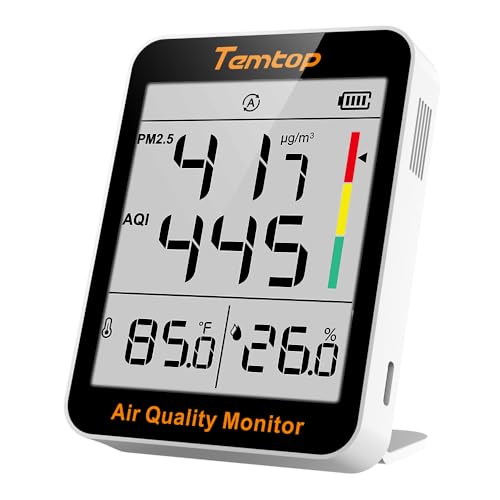
Improve Your Comfort & Health: Air Quality Monitor + Indoor Thermometer This smart air quality monitor continuously tracks PM2.5 and AQI, while also serving as a precise indoor thermometer and thermo-hygrometer for temperature and humidity. Understand whether your environment is both healthy and comfortable.

NEW GEN 2 AIR QUALITY MONITOR – 90-DAY HISTORY & 6-HOUR BATTERY: The latest BREATHE Airmonitor Plus Gen 2 features upgraded battery performance with up to 6 hours of portable use, plus 90-day app data history and data export. Monitor longer, review historical trends and export your indoor air quality data for deeper analysis.
What Your CO2 Levels Tell You About Indoor Air Quality
CO₂ levels below 1,000 ppm indicate good indoor air quality and adequate ventilation. Outdoor air typically sits around 400 ppm, so indoor levels in the 600–800 ppm range show that fresh air is entering effectively. When levels reach 800–1,000 ppm, you’re approaching the upper acceptable limit, signaling that ventilation could be improved. If CO₂ surpasses 1,000 ppm, it suggests poor airflow, and opening windows or adjusting your HVAC system can help restore proper air exchange. For spaces that also suffer from airborne particles, using an air cleaner can further improve overall air quality alongside better ventilation.
Higher CO₂ concentrations—between 1,000 and 2,000 ppm—are associated with feelings of drowsiness and a decline in perceived air quality. Once levels hit 2,000 to 5,000 ppm, you may experience headaches, fatigue, and difficulty concentrating. These signs indicate stale, under-ventilated air rather than toxicity. Keeping CO₂ levels below 1,000 ppm supports better comfort and enhances mental clarity during indoor activities. Selecting a model with a high-efficiency filter ensures that particulate removal keeps pace with ventilation efforts, especially in rooms where pollutant sources are present.
How to Spot PM2.5 and VOC Spikes From Everyday Activities
Sudden jumps in PM2.5 and VOC levels are usually linked to specific activities. For example, during cooking—particularly frying or searing—PM2.5 particles can increase sharply, often peaking about 15 minutes after finishing. VOC levels tend to reach their highest approximately 5 minutes after you stop cooking. Using a benefits air purifier during these times can rapidly filter out harmful particles and improve overall comfort. Cleaning routines also cause quick spikes in VOCs, especially if you use ammonia, bleach, or heavily scented sprays. These spikes typically resolve within an hour or two, indicating a direct connection to recent activity. If you notice a spike without an obvious cause that persists for hours, it could signal ongoing pollution problems. Keep in mind that closed windows trap pollutants inside, and higher humidity and warmth can increase off-gassing from furniture or building materials. A top fan tower can help circulate and filter air more effectively in larger rooms. Using exhaust fans during and after activities can help reduce these pollutant levels quickly. Integrating a smart thermostat can help schedule exhaust fan operation to automatically clear these spikes.

𝐆𝐄𝐍𝐔𝐈𝐍𝐄 𝐑𝐄𝐏𝐋𝐀𝐂𝐄𝐌𝐄𝐍𝐓 𝐅𝐈𝐋𝐓𝐄𝐑: Designed for Core 400S-P air purifiers to maintain peak performance. Use genuine filters for premium quality and longer lifespan.

𝐆𝐄𝐍𝐔𝐈𝐍𝐄 𝐑𝐄𝐏𝐋𝐀𝐂𝐄𝐌𝐄𝐍𝐓 𝐅𝐈𝐋𝐓𝐄𝐑: Designed for Levoit EverestAir-P Smart air purifier to maintain peak performance. Use genuine filters for premium quality and longer lifespan.

𝐆𝐄𝐍𝐔𝐈𝐍𝐄 𝐑𝐄𝐏𝐋𝐀𝐂𝐄𝐌𝐄𝐍𝐓 𝐅𝐈𝐋𝐓𝐄𝐑: Designed for Core 400S-P air purifiers to maintain peak performance. Use genuine filters for premium quality and longer lifespan.
How Long Should You Monitor Before Reading Results?
For radon, you need 7 to 30 or more days of sampling to get a reliable long-term average. Formaldehyde readings can be taken in about 30 minutes, and TVOCs in around 8 hours. Don’t rush the process—your sampling duration must cover variations over time, not just a quick snapshot. Longer testing periods capture daily fluctuations and repeated activities that influence the levels. If you don’t allow enough time, your results can be misleading. Choose a sampling window that aligns with your goal: a brief test for quick screening or an extended period for an accurate exposure assessment. Maintaining lower humidity levels with a dehumidifier for centipedes also helps reduce the moisture that attracts these pests into your home. To further improve air quality, ensure you are maximizing your reed diffuser for consistent scent release and freshness. Using a reliable humidifier for moisture-loving plants like calathea can also stabilize humidity in a beneficial range.
Should You Compare Indoor Air to Outdoor Air Quality?
Comparing indoor air to outdoor air quality provides essential context for understanding pollution sources and risks. Because you spend most of your time inside, where pollutant levels can be two to five times higher than outside, checking both readings simultaneously helps identify the cause of indoor air issues.
If indoor measurements significantly exceed outdoor levels, it’s likely due to indoor sources such as cooking, smoking, or off-gassing furniture. In contrast, if indoor levels closely track outdoor levels, infiltration—the process of outdoor air seeping inside—is probably the main contributor. Measurements of PM2.5 and formaldehyde are especially useful for this comparison.
Outdoor air quality strongly impacts indoor air, so ignoring outdoor conditions can lead to misunderstood or ineffective interventions. However, it’s important not to assume outdoor air is always cleaner. Both indoor and outdoor measurements should be considered together to accurately pinpoint pollution sources and take appropriate action.
What to Do When Your Air Quality Readings Look Bad
If indoor readings are significantly higher than outdoor levels or indicate a health concern, act immediately. First, recheck your device in the same location to confirm the reading is accurate and not a sensor glitch. Review your air quality trend data to determine if this is a temporary spike or a persistent problem. If the reading suggests carbon monoxide, treat it as an emergency—evacuate the space and call emergency services. Long-term exposure to poor IAQ increases risks of cardiovascular disease and weakens immune response.
Next, identify and eliminate pollution sources. Stop smoking indoors, remove scented products like air fresheners and candles, and fix leaks or mold issues that can worsen indoor air quality. Improve ventilation by opening windows or running exhaust fans to dilute indoor pollutants. Use a HEPA air cleaner to filter out particles and consider a dehumidifier if humidity is above 50 percent to prevent mold growth. If problems persist or you’re unsure about radon levels, test for radon or contact a professional for comprehensive evaluation. Acting quickly helps restore safe air quality and protects your health.

WHY CHOOSE AHAM VERIFIDE AIR PURIFIERS: AHAM (Association of Home Appliance Manufacturers) is an ANSI-accredited organization that sets strict standards for appliance performance. Air purifiers with the AHAM VERIFIDE seal have been independently tested for air cleaning performance and energy efficiency. When you choose an AHAM certified air purifier, you're choosing a product trusted for reliable and effective indoor air quality improvement

𝐖𝐇𝐘 𝐂𝐇𝐎𝐎𝐒𝐄 𝐀𝐇𝐀𝐌 𝐕𝐄𝐑𝐈𝐅𝐈𝐃𝐄 𝐏𝐑𝐎𝐃𝐔𝐂𝐓𝐒: AHAM (Association of Home Appliance Manufacturers) is an ANSI-accredited organization that sets strict standards for appliance performance. Air purifiers with the AHAM VERIFIDE seal have been independently tested for air cleaning performance, safety, and energy efficiency. When you choose an AHAM certified air purifier, you're choosing a product trusted for reliable and effective indoor air quality improvement.

𝐇𝐢𝐠𝐡𝐞𝐫 𝐀𝐢𝐫 𝐈𝐧𝐭𝐚𝐤𝐞 & 𝐋𝐚𝐫𝐠𝐞𝐫 𝐂𝐨𝐯𝐞𝐫𝐚𝐠𝐞 𝐟𝐨𝐫 𝐏𝐞𝐭 𝐋𝐨𝐯𝐞𝐫𝐬: This air purifier for home pets is designed with a larger front air inlet and wider dual-side air inlet, which can pull air from multiple sides and trap airborne pet hairs and odors more easily. Engineered to tackle the wildfire smoke, floating ash, and heavy smog, this high-performance air purifier creates a safe haven indoors, keeping your indoor air fresh during severe air quality alerts