What Does an Air Purifier Do?
If you’ve ever wondered how air purifiers actually improve indoor air quality, you’re not alone. They pull in dirty air, trap pollutants like dust, pollen, and pet dander, and then release cleaner air back into your space.
While they can significantly reduce airborne particles, they won’t remove settled dust or mold. Keep reading to learn how to choose and use one effectively.
What Pollutants Can an Air Purifier Remove From Your Air?
Mechanical filtration excels at capturing PM2.5 fine particulate matter but is not reliable for removing chemical vapors like formaldehyde unless paired with a dedicated sorbent filter. These filters are designed to target specific volatile organic compounds and heavy industrial chemicals that may be carried on airborne droplets rather than in gas form. While particle reduction is their primary strength, vapor elimination requires additional filtration features. Top air purifiers with ionizer combine both particle capture and chemical-neutralizing capabilities for cleaner indoor air. Be aware of this limitation when selecting an air purifier, especially if chemical odors or fumes are a concern. A window air conditioner can provide cool comfort but does not offer the same specialized filtration for chemical vapors that a dedicated sorbent filter provides. For persistent moisture issues, a bedroom dehumidifier can help reduce humidity that often worsens chemical off-gassing.
Will an Air Purifier Help With Your Allergies or Asthma?
Yes, an air purifier can help reduce your allergy and asthma symptoms, but it is not a cure-all. It effectively removes airborne allergens such as pollen, dust, and pet dander, which can trigger sneezing, coughing, and congestion. You’re likely to see the most benefit if you use a HEPA purifier regularly in your bedroom, especially during pollen season. However, an air purifier does not clear settled allergens on floors or furniture. Regular cleaning and ventilation remain essential. For asthma, purifiers can help when indoor particles contribute to symptoms, but their impact tends to be modest. Think of an air purifier as a helpful addition, reducing airborne triggers and potentially allowing you to decrease medication, but it should not replace prescribed treatments or avoidance strategies. Choosing a model that balances quality and performance can ensure you get the most benefit from your investment. Unlike a humidifier, which adds moisture to the air through evaporation or ultrasonic vibration, an air purifier focuses solely on filtering particulate matter from the air. For those seeking added humidity, a warm mist humidifier can complement an air purifier by soothing dry airways while the purifier handles allergens.
The 3 Air Purifier Filtration Technologies Explained
Most air purifiers rely on three main filtration technologies to clean your air effectively. HEPA or mechanical filtration uses a fan to pull air through a dense fiber mat, trapping 99.97% of particles as small as 0.3 microns. This includes dust, pollen, and smoke but does not remove gases or odors. To handle those, activated carbon filters adsorb cooking smells, volatile organic compounds (VOCs), and pet odors. However, they are less effective against certain gases like formaldehyde. Pre-filtration captures larger particles such as hair and lint before they reach the finer filters, helping to extend their lifespan and maintain efficiency. Real-world performance depends on the fan speed and room size to ensure adequate air exchange. This three-stage approach enhances overall air exchange and keeps your environment cleaner, all without relying on ozone-generating technologies. For example, the Winix achieved the best combined performance in particle and smoke removal, leaving no detectable smoke particles after cleanup.
How an Air Purifier Works in 4 Simple Steps
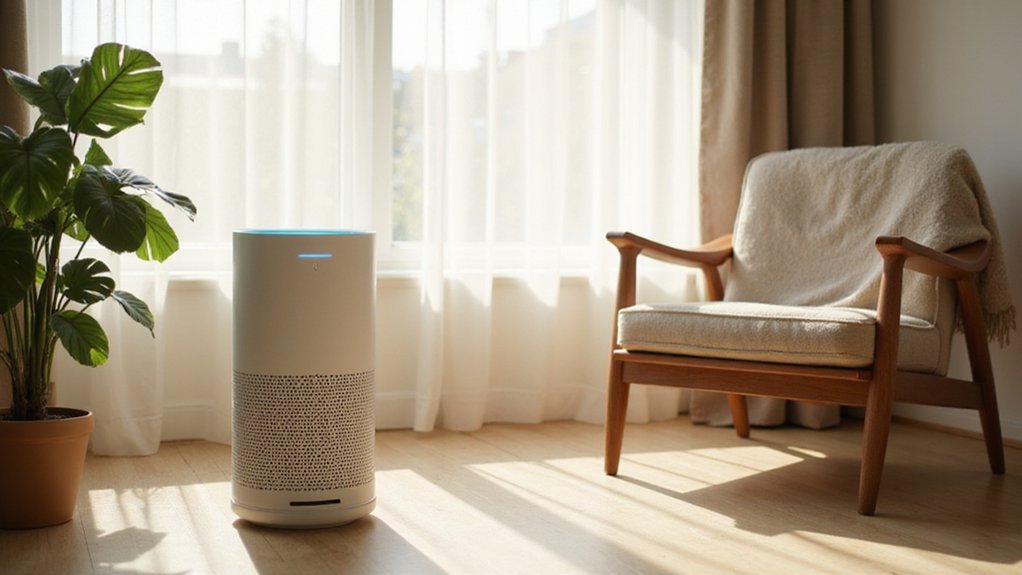
Once you turn on the air purifier, an internal fan pulls room air into the device from the side, rear, or bottom, creating a continuous cycle that continuously filters the air without generating new oxygen or fresh air.
First, a pre-filter captures larger debris like dust and pet fur. This prevents it from clogging the main filter and makes maintenance easier. You can often vacuum or wash this pre-filter to keep it working effectively.
Next, the main filtration stage—usually a HEPA filter—traps tiny particles such as pollen and mold spores. It is designed to remove airborne contaminants that can cause allergies or respiratory issues. This HEPA filter removes 99.97% of particles as small as 0.3 microns. To target musty smells specifically, you may also want a dehumidifier to reduce the moisture that mold needs to grow. For year-round comfort and efficiency, you might pair this with a smart thermostat that automatically adjusts temperature settings. Using a dehumidifier also helps keep centipedes out by eliminating the damp environments they prefer.
An activated carbon layer follows, absorbing odors and volatile organic compounds, or VOCs, that contribute to indoor pollution and unpleasant smells.
Finally, the cleaned air is pushed back into the room from the top of the unit, improving airflow and circulation. This process repeats continuously, reducing pollutant levels over time. Keep in mind that higher fan speeds can improve cleaning efficiency but tend to make the device louder, so you might want to adjust the speed based on your comfort preferences.
How Much Cleaner Air Can You Expect in a Real Room?
You can typically expect PM2.5 levels to drop by 50 percent or more in a real room if your air purifier is properly sized and operated continuously. While a HEPA filter can capture over 99 percent of particles in controlled lab settings, real-world conditions usually result in more modest reductions. In practical tests, reductions range from about 50 to 90 percent, depending heavily on room size and how often the air is exchanged. To maintain optimal performance, it is also important to follow effective humidifier cleaning tips to prevent mold and buildup that could affect overall indoor air quality. For spaces that are poorly ventilated, an air circulator can help move air more effectively than a standard fan, but it does not filter out pollutants. Choosing a humidifier for home alongside your purifier can help maintain balanced humidity levels.
Keep in mind that particles often rebound within hours after you turn off the purifier. For consistent cleaner air, running your device continuously is key. Relying on ionizers isn’t advisable since they are less effective than HEPA filters and can even produce ozone, which is harmful. Mechanical filtration with a properly maintained HEPA filter provides the most reliable results. Regularly replacing the filter as per the manufacturer’s schedule is crucial because a clogged filter hampers performance.
In occupied homes, reductions typically fall between 29 and 78 percent, influenced by ventilation levels, sources of pollution, and whether doors remain closed. Achieving cleaner air is possible, but it requires persistent effort and proper device use instead of expecting automatic improvement.
Where Air Purifiers Fall Short: 5 Common Limits
An air purifier alone cannot eliminate all indoor pollutants. Its coverage is limited to the size of the room it is placed in, so it doesn’t address pollutants in other areas. When doors are open or occupancy is continuous, its effectiveness decreases significantly. For a more comprehensive airflow solution, consider using a ceiling fan to help circulate and distribute conditioned air throughout the room.
Particle filters are designed to trap dust, pollen, and pet dander but do little to remove gases or volatile organic compounds (VOCs). Some ionizers emit ozone or formaldehyde, which can worsen air quality and harm your health, especially for sensitive individuals like asthmatics. For a more comprehensive solution, consider a model that also provides dehumidifier performance to manage moisture levels.
These devices also cannot clean settled surface grime such as dust on furniture or mold on walls. That requires manual cleaning, vacuuming, or wiping. Relying solely on an air purifier may give a false sense of security and overlook the need for proper ventilation and routine cleaning.
Ozone-emitting models pose safety concerns because they can irritate the lungs. Operational costs add up over time through filter replacements and energy consumption, while noise levels can become disruptive. As the media load increases, the Clean Air Delivery Rate (CADR) declines, meaning you’ll need additional measures to maintain indoor air quality. Unlike humidifiers that add moisture to the air, air purifiers only target airborne particles.
How to Pick the Right Size Purifier for Your Room
To choose the right size purifier, measure your room’s square footage by multiplying the length by the width. For irregular or connected spaces, break them into rectangles, find each area, then add them together. Don’t forget to account for ceiling height—standard rules assume 8 feet, but higher ceilings like vaulted ones increase the volume, requiring a higher Clean Air Delivery Rate (CADR). Use CADR as your main measure: aim for a value at least two-thirds of your room’s square footage. For example, in a bedroom under 300 square feet, target a purifier with a CADR of 100 to 200 cubic feet per minute (CFM). Oversizing the unit may cost more upfront but allows you to run it at lower, quieter speeds. This results in better energy efficiency and less wear on the filter. Properly sized purifiers save money in the long run by maximizing performance and maintaining cleaner air.
Where to Place Your Air Purifier for Maximum Results
To maximize your air purifier’s effectiveness, placement is key. Position it where airflow can reach it freely and near the source of pollution when possible. For broad coverage, place the purifier near the center of the room to promote even circulation. Keep at least three to five feet of open space around the unit to prevent blockages and ensure proper airflow—avoid placing it in corners, behind furniture, or near curtains that can impede intake and output.
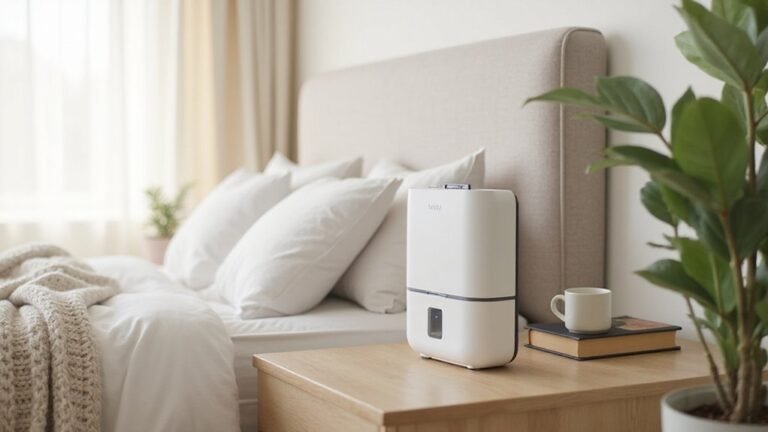
In bedrooms, set the purifier a few feet from your bed on an elevated surface like a nightstand, not directly on the floor. Keep the door closed and stay clear of nearby airflow sources such as fans or HVAC vents that could interfere with its operation. Some people choose a white noise machine instead of a fan for masking sound, but an air purifier offers the dual benefit of cleaning the air. In kitchens, position the purifier close to cooking areas but away from direct heat sources. These simple steps help the purifier to deliver cleaner air to you more quickly. For ongoing effectiveness, regularly monitor indoor pollution levels to confirm the purifier is working as intended. Additionally, if you experience frequent bloody noses, using a humidifier alongside your purifier can help maintain optimal moisture levels.