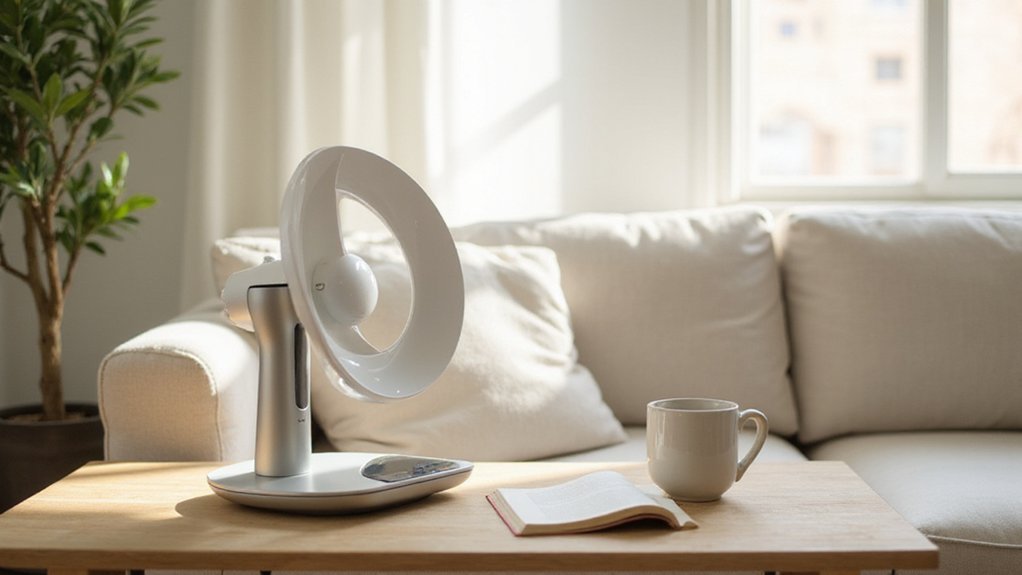
What Is a Bladeless Fan and How Does It Work?
Ever wonder how a bladeless fan creates that smooth, steady breeze without visible spinning blades? Instead of traditional blades, it uses a hidden motor inside the base to draw air in and then propel it through a hollow ring.
This design pulls in more surrounding air to boost airflow significantly. It offers a quieter, safer, and more modern way to stay cool. Keep reading to see exactly how it works.
What Exactly Is a Bladeless Fan?
A bladeless fan is a device that has no visible external spinning blades. Instead, it features a smooth, hollow ring or loop mounted on a pedestal, giving it a sleek and modern appearance. Although called “bladeless,” internal blades are hidden inside the base, typically smaller and less conspicuous than those in traditional fans. This hidden base relies on the air multiplier principle to draw in surrounding air and amplify the airflow. This design emphasizes safety and quieter operation, similar to how a bedroom ceiling fan can improve air circulation without harsh drafts. For those seeking a similar cooling solution, window air conditioners are top picks for cool comfort that provide powerful, directed cooling. The airflow produced is smoother and more continuous, resulting in less choppiness and a more comfortable breeze. The upper section acts as an air channel, guiding the airflow outward without exposing fast-moving blades. Overall, a bladeless fan offers a stylish, safer alternative to conventional fans while delivering consistent, gentle air movement. When choosing a model for a bedroom, factors like noise levels and energy efficiency are just as critical as the aesthetic appeal.
How a Bladeless Fan Moves Air Without Visible Blades
A bladeless fan moves air without visible blades by using internal components hidden inside the base. A brushless motor spins a centrifugal impeller, which draws air in through small vents. This impeller forces the air upward into the toroidal ring, where it exits through a narrow slit at high speed. The fast jet of air then takes advantage of the Coandă effect: it hugs the ring’s curved surface instead of shooting straight out. This attachment creates a low-pressure zone that pulls in surrounding air through entrainment, amplifying the airflow. The combined mechanisms multiply the initial airflow about 15 times, ensuring efficient air circulation. This efficiency is further supported by the aerodynamic design of the ring, which minimizes turbulence and energy loss. As a result, you experience a smooth, continuous breeze that is intensified up to 18 times compared to the initial jet, providing a steady, gentle flow. This method ensures there are no exposed blades, making the airflow feel more natural and safer while maintaining a sleek, modern appearance. However, you must still follow basic safety precautions to prevent fire hazards from electrical components or overheating. For additional moisture control, you might consider pairing your fan with a bedroom dehumidifier to maintain optimal air quality and comfort.
Bladeless Fan vs. Traditional Fan: Key Differences
A bladeless fan is generally safer than a traditional fan because it has no visible moving blades, reducing the risk of injury to curious children or pets. The airflow produced by a bladeless fan feels smoother and more consistent, unlike the choppy, pulsed breezes often generated by spinning blades. Additionally, bladeless fans tend to operate quieter and vibrate less, enhancing comfort and reducing noise disturbance. However, these safety and comfort benefits usually come with a higher upfront cost compared to traditional fans. This is achieved through a process of air acceleration and induction, similar to how a humidifier moves air efficiently.

【Find Your Ideal Airflow in Seconds】Choose from 5 fan speeds to match your daily needs. Levels 1–2 provide a gentle breeze for nurseries or quiet moments, Levels 3–4 deliver balanced airflow for everyday desktop use, and Level 5 provides stronger airflow when you need extra cooling. Simple one-button controls make it easy to adjust the airflow for your bedroom, office, or workspace.

【Futuristic Bladeless Design】: Compared to traditional fan, this small desk fan adopts turbine technology, which is a perfect combination of functionality and design. You will never worry about hurting fingers, safe for babies, kids, and pets. Besides, due to the bladeless design, this fan is easy to clean, saving you a lot of time.

𝐏𝐨𝐰𝐞𝐫𝐟𝐮𝐥 𝐀𝐢𝐫𝐟𝐥𝐨𝐰 𝐰𝐢𝐭𝐡 𝐮𝐩𝐠𝐫𝐚𝐝𝐞𝐝 𝐃𝐂 𝐦𝐨𝐭𝐨𝐫: Thanks to DREO's upgraded brushless DC motor combined, the tower fan achieves faster spin to deliver stronger airflow, with airflow speeds reaching up to 28ft/s and projecting up to 34ft.
Do Bladeless Fans Use Less Energy Than Regular Fans?
Yes, bladeless fans typically use less energy than traditional fans, but the savings are modest. Most bladeless units draw between 20 and 60 watts, with many medium-sized models around 40 watts. In comparison, traditional fans often draw 50 watts or more. Over a day, a bladeless fan may consume about 0.96 kilowatt-hours (kWh), while a standard fan uses roughly 1.2 kWh. This results in a small energy efficiency advantage for bladeless fans. However, actual power consumption depends on the model, the speed setting, and how much air it pushes. A less powerful bladeless fan might use less energy but could also be less effective at cooling. Ultimately, the motor type and overall design have a bigger impact on energy use than the “bladeless” feature alone. For those concerned with throat mucus relief, maintaining proper humidifier levels in a room can also influence comfort and respiratory health. Additionally, using a dehumidifier to keep indoor humidity below 50% can help deter pests like centipedes, as these creatures thrive in damp environments. For a cohesive bedroom aesthetic, the ceiling fan color you choose should complement your wall paint and furniture tones.

𝗖𝗼𝗺𝗳𝗼𝗿𝘁 𝗪𝗶𝘁𝗵𝗼𝘂𝘁 𝗖𝗼𝗺𝗽𝗿𝗼𝗺𝗶𝘀𝗲: With an efficient DC motor and VortexAir Technology, this fan produces high-performance airflow and a strong, focused breeze for consistent comfort

Safe for All Ages: Our bladeless fan is designed with safety in mind, making it perfect for households with children and pets. Without exposed blades, there's no risk of accidental injury, ensuring peace of mind for you and your family.

𝗖𝗼𝗺𝗳𝗼𝗿𝘁 𝗪𝗶𝘁𝗵𝗼𝘂𝘁 𝗖𝗼𝗺𝗽𝗿𝗼𝗺𝗶𝘀𝗲: With an efficient DC motor and VortexAir Technology, this fan produces high-performance airflow and a strong, focused breeze for consistent comfort.
Are Bladeless Fans Worth the Higher Price Tag?
Bladeless fans are significantly more expensive than traditional models, often costing three to ten times as much upfront. This higher price reflects design innovations that prioritize safety and comfort. You pay extra for features like the elimination of exposed blades, making them safer around children and pets. They also deliver quieter, smoother airflow, which is better suited for bedrooms or offices, and are easier to clean without removing grilles.
However, bladeless fans usually produce less airflow per dollar compared to high-velocity traditional fans. Consider whether your priority is safety, quiet operation, and aesthetic appeal over maximum cooling power. If these factors are important to you—such as having a safer, quieter, and sleeker fan—the higher cost can be justified. Conversely, if you mainly need strong airflow at a lower price, a standard fan might remain the smarter choice.

32-INCH TOWER DESIGN: Ultra-slim profile provides effective air circulation while saving valuable floor space in your home or office.
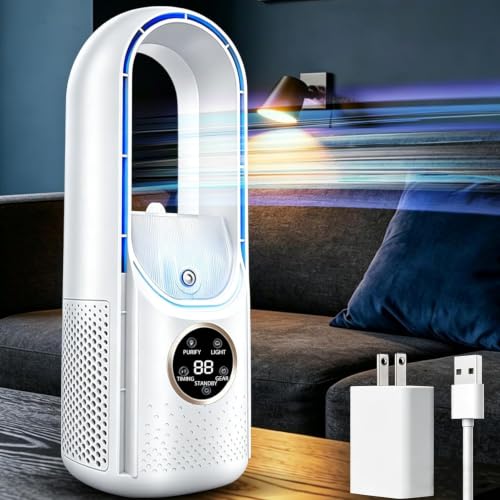
🌪 Bladeless Safety Design:This bladeless desk fan provides smooth airflow without exposed blades, making it a safer choice for homes with children and pets. (No Battery !!!)
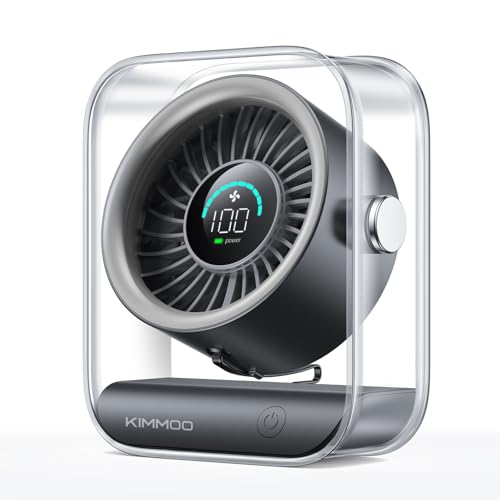
Ultra-Quiet Operation: At its lowest setting (Speed 1), the fan operates at just 35dB, providing a whisper-quiet and comfortable breeze for undisturbed relaxation.