How Do Bladeless Fans Work?
You might think of bladeless fans as completely free of blades, but there’s actually a small impeller hidden inside the base. This tiny motor pulls in air and sends it up into a smooth, curved ring.
From there, a narrow slit shoots out a high-speed jet of air that feels natural and gentle. The magic lies in how the design amplifies airflow and creates that steady breeze you’re after.
The full story behind how they work is pretty fascinating.
Why “Bladeless” Fans Still Have Hidden Blades?
Although they are called “bladeless,” these fans still have hidden blades—usually a small impeller or propeller concealed inside the base. The material of these blades is often a durable plastic or metal designed to withstand high speeds without warping or breaking. This internal rotor pulls air in through the base, creating the airflow you feel. The visible ring, regardless of the fan’s color, serves solely as the outlet. The moving parts stay hidden inside, so you don’t see the blades while the fan operates. Instead, the entire mechanism relies on concealed engineering to guide the air upward through the ring. The smooth airflow produced by this design is often compared to the gentle, consistent mist from an essential oil diffuser. A similar principle of using hidden internal components to manage airflow is also applied in appliances like dehumidifiers for silverfish, which rely on concealed fans to reduce humidity and deter pests. Regular cleaning of these concealed components is essential to prevent mold and buildup, ensuring optimal performance and longevity of the device.
The term “bladeless” is mainly marketing language that emphasizes the absence of exposed blades. In reality, the fan relies on concealed blades to generate the airflow. These hidden blades act as the main air source, drawing air in and feeding it upward through the ring. Without them, the ring alone would produce no airflow. So while the blades are concealed inside, they are still present and essential to the fan’s functioning.

LED DIMMABLE: Soft led light source does not irritate the eyes, no flash, energy and money saving. Dimmable performance can adjust the bladeless ceiling fan's color temperature and brightness according to demand, creating a bright or warm and other different atmosphere. Suitable for kids room, bedroom, kitchen, living room and other places

Indoor/Outdoor Use: The LivePure LP1780 bladeless fan is designed for both indoor and outdoor use, making it perfect for a variety of settings such as porches, screen rooms, camping trips, pools, beaches, decks, RVs, and more.

Safe for All Ages: Our bladeless fan is designed with safety in mind, making it perfect for households with children and pets. Without exposed blades, there's no risk of accidental injury, ensuring peace of mind for you and your family.
How a Bladeless Fan’s Base Pulls Air In and Pushes It Up?
When air exits the ring, it creates a pressure difference that forms a low-pressure zone, which actively pulls in surrounding air into the stream. This process begins with the base supplying a small, steady seed airflow. As the air moves through the ring, its geometry amplifies this initial flow, increasing the airflow by approximately 15 times. The result is a smooth, continuous breeze that feels much stronger than what the base alone could generate. This airflow amplification relies on the pressure difference generated at the ring, which entrains more air, creating a powerful and maintaining airflow without the need for traditional blades. The acceleration of airflow is further enhanced by the Coanda effect, which causes the air to cling to the ring’s curved surface. Unlike a traditional window unit, a bladeless fan achieves this effect without filthy air filters that need frequent cleaning. For similar reasons, large room humidifiers rely on effective airflow to distribute moisture evenly throughout a space. In contrast, reducing household humidity with a dehumidifier can help deter centipedes by eliminating the damp conditions they prefer.
The Slit That Makes a Bladeless Fan’s Jet So Fast
The slit that makes a bladeless fan’s jet so fast is typically just 1 to 2 millimeters wide. Narrowing this slit increases the exit velocity dramatically by forcing the same amount of compressed air through a smaller opening. For example, reducing the slit from 1.5 mm to 0.25 mm can nearly triple the flow’s discharge ratio, making the slit size a critical factor in your design. When selecting a bedroom dehumidifier, you should also consider critical factor like airflow and noise levels for optimal comfort. For large spaces, similar considerations apply when choosing an air purifier, as optimal coverage ensures efficient pollutant removal.
This focused, high-speed jet changes how the surrounding airflow moves around the fan’s ring. As the jet accelerates through the narrow slit, it creates a pressure drop near the inner lip. This low-pressure zone actively pulls in more ambient air, amplifying the overall airflow. With optimized slit geometry, your fan can produce up to 15 times the base airflow, all through clever slit size tuning.

Bladeless Design: Safe, quiet, and easy to clean (no more dusty blades!). The arched air outlet delivers wider, gentler cooling than traditional fans—no harsh gusts, just smooth, natural breeze. Our breakthrough dual-turbine boost system, enhanced by advanced aerodynamics, generates 60% more airflow than traditional bladeless table fans
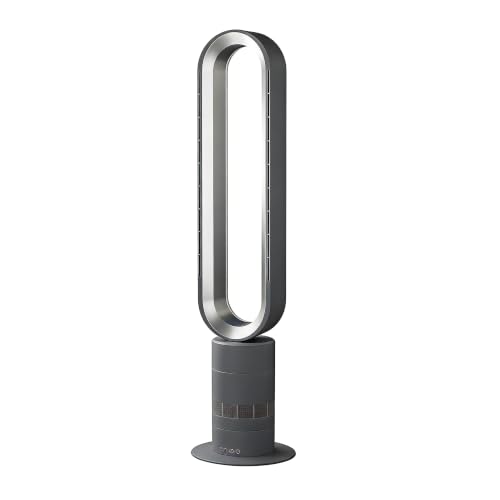
SAFE & GENTLE BLADELESS AIRFLOW – Designed without exposed fan blades, this fan delivers smooth, uninterrupted airflow with no harsh buffeting. The soft, natural breeze greatly reduces safety risks, making it ideal for homes with children and pets.
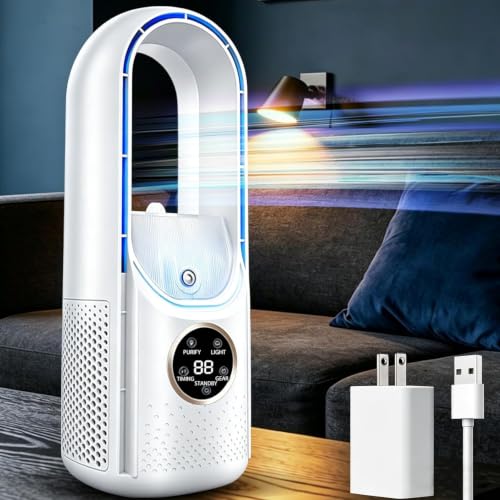
🌪 Bladeless Safety Design:This bladeless desk fan provides smooth airflow without exposed blades, making it a safer choice for homes with children and pets. (No Battery !!!)
Why the Curved Surface of a Bladeless Fan Steers the Air (Coanda Effect)
The curved surface of a bladeless fan steers the air through the Coanda effect. When the fan is powered on, the high-speed jet emitted from the slit hugs the ring’s curved surface instead of dispersing in a straight line. This occurs because the jet entrains the surrounding air, creating a low-pressure zone that pulls the airflow toward the surface. The smooth curvature of the ring guides the jet along its contour, preventing separation and maintaining a continuous flow along the shape.
Simulations reveal that there is an optimal curvature—too sharp, and the airflow detaches from the surface; too flat, and the steering effect diminishes. The curved surface effectively directs the jet around the hoop, sweeping the air in a controlled, consistent stream. This attachment not only contours the airflow but also produces a low-pressure zone that helps the jet stay attached without the need for spinning blades.

【Find Your Ideal Airflow in Seconds】Choose from 5 fan speeds to match your daily needs. Levels 1–2 provide a gentle breeze for nurseries or quiet moments, Levels 3–4 deliver balanced airflow for everyday desktop use, and Level 5 provides stronger airflow when you need extra cooling. Simple one-button controls make it easy to adjust the airflow for your bedroom, office, or workspace.

Bladeless Construction: Innovative bladeless design for safe use around kids and pets. This unique technology allows for safe and efficient airflow, eliminating the risk of dust build-up spreading throughout the room. This fan produces a steady, smooth, and fresh airflow which is gentler and more comfortable compared to traditional fans.
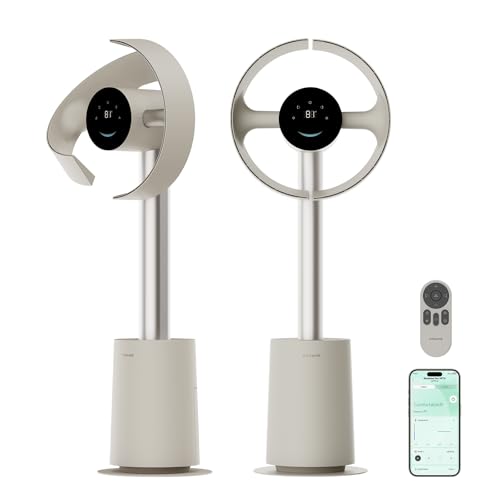
Whole-Room Air Circulation by GyroWing: Driven by two GyroWing rotating independently up to 90° vertically, the system delivers up to 270° airflow coverage, helping mix air evenly and reduce hot and cold layers for balanced comfort across seasons.
How Low Pressure in a Bladeless Fan Multiplies the Airflow
The low-pressure zone created by the bladeless fan multiplies airflow by drawing in surrounding air through entrainment. When the impeller accelerates air through a narrow slit, it generates a high-velocity jet whose pressure drops, forming a low-pressure area on the ring’s inner side. Air naturally moves from high to low pressure, so this low-pressure zone pulls in ambient air from around the fan. As this air joins the central jet, it amplifies the overall airflow significantly. This process increases the total volume of air moved by roughly 15 to 16 times, effectively turning a modest initial flow into a powerful, continuous stream. The same principle of air entrainment is used in a DIY home diffuser to amplify the output of essential oils without requiring a large fan. When comparing this method to a window air conditioner, the cooling efficiency per unit of energy consumed can differ substantially due to how each system moves and conditions air. The same entrainment principle is also key to how top dehumidifiers combat window condensation by pulling moisture from the air.
What Makes the Bladeless Fan Breeze Feel Different From a Traditional Fan
A bladeless fan breeze feels noticeably different from a traditional fan because it produces a smooth, continuous airflow instead of pulsing gusts. This results in a more natural, gentle breeze that avoids the sudden, choppy sensations you might experience with standard fans. The airflow is laminar and well-organized, which reduces random air surges and turbulence. As a result, you can sit closer to the fan without feeling blasted or buffeted by blades chopping the air. The steady stream also means less noise and less skin drying, creating a more comfortable environment. Additionally, the sleek, modern design enhances aesthetic appeal, making bladeless fans not only functional but stylish. Overall, the experience is a softer, more consistent breeze that mimics nature more closely than traditional fans do.